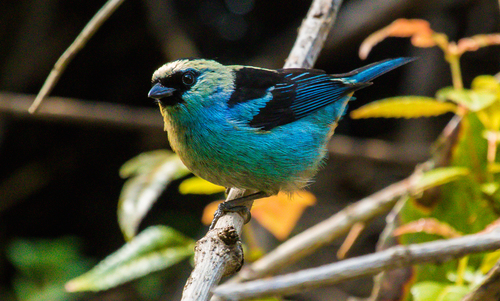
Metallic-green Tanager
Tangara labradorides
A shimmering emerald of the Andes, the Metallic-green Tanager is a master of acrobatic foraging. Found in the lush cloud forests of Colombia, Ecuador, and Peru, this social bird brings a flash of iridescent color to the high-altitude canopy.
Quick Identification
Size
12-13 cm (4.7-5.1 inches) in length; weighing approximately 14-20 g (0.5-0.7 oz)
Colors
Brilliant metallic green to turquoise-blue plumage; black mask (lores) around the eyes; pale golden-buff undertail coverts; wings and tail edged in blue.
Key Features
- Iridescent metallic green plumage that shifts to blue in certain light
- Small black mask between the eye and the bill
- Distinctive pale buff or golden vent and undertail area
- Acrobatic foraging behavior, often hanging upside down.
When You’ll See Them
Geographic range
Where Does the Metallic-green Tanager Live?
The Metallic-green Tanager is a jewel of the South American Andes. It is natively found along the humid slopes of the mountain ranges in Colombia, extending through the western and eastern slopes of Ecuador and reaching its southern limit in northern Peru. This species is a highland specialist, rarely straying far from the mist-shrouded tropical forests of the middle elevations.
Basemap © OpenStreetMap contributors
Behavior
The Metallic-green Tanager is a high-energy, social bird of the Andean cloud forests. Unlike some solitary species, these tanagers are rarely found alone; they typically travel in small family groups of three to eight individuals. They are also enthusiastic participants in mixed-species foraging flocks, often seen alongside flowerpiercers, woodcreepers, and other members of the Tangara genus as they move rapidly through the canopy.
In the backyard or garden setting, they are shy but curious. They spend most of their time in the mid-to-upper levels of trees, darting between branches with buzzy, high-pitched vocalizations. While they aren't as aggressive as larger birds, they are quick and efficient foragers, often being the first to spot a newly ripened bunch of berries before moving on to the next tree in their circuit.
EverydayEarth exclusive
Camera Tips
To successfully capture the Metallic-green Tanager on your AI camera, height is the most critical factor. These birds rarely descend to ground level, so mount your camera at least 5 to 10 feet high on a sturdy branch or a pole near the forest edge. If you have a balcony overlooking a wooded slope, this is the perfect vantage point. Focus your camera on 'perching spots'—dead twigs or horizontal branches that offer a clear view of the bird away from dense foliage.
Lighting is the second most important element for this species. Their plumage is iridescent, meaning it requires direct or bright diffused light to reveal the 'metallic' green and blue tones. If your camera is placed in deep shade, the bird may look like a dark, nondescript shape. Position the camera to face north or south to avoid harsh backlighting from the sun, which can wash out the subtle color transitions on their feathers.
Baiting with fruit is highly effective for this species. They are particularly fond of ripe bananas and plantains. Using a platform feeder or skewering fruit onto a branch within the camera's field of view will encourage them to stay in the frame long enough for the AI to trigger. Set your camera to 'Burst Mode' or high-definition video; because they are fast and twitchy, you’ll want multiple frames to ensure you catch that perfect moment when their feathers catch the light.
Similar Species
Species that look similar or are commonly confused with Metallic-green Tanager.
Frequently Asked Questions
Record Metallic-green Tanager at your habitat
Connect a camera to start building your own species record — AI identifies every visitor automatically.