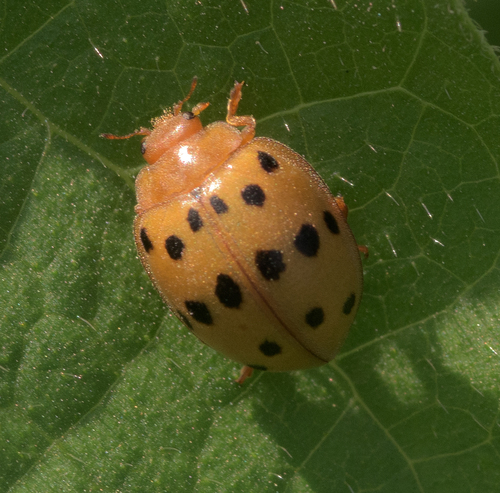
Mexican Bean Beetle
Epilachna varivestis
A striking copper-colored cousin of the common ladybug, the Mexican Bean Beetle is a master of the legume patch. While its 16-spotted coat is beautiful, this unique beetle is best known for its voracious appetite for garden beans.
Quick Identification
Size
6–8 mm (0.24–0.31 inches) long; roughly the size of a standard pea.
Colors
Bright copper, bronze, or yellowish-orange body with 16 distinct black spots (8 on each wing cover); larvae are bright yellow with dark-tipped spines.
Key Features
- Copper to yellowish-orange convex body
- 16 small black spots arranged in three rows
- Lacks the white 'M' or 'W' marking on the pronotum found in similar species
- Larvae are yellow and covered in branched, fuzzy-looking spines
When You’ll See Them
Geographic range
Where Does the Mexican Bean Beetle Live?
Native to the plateau regions of Mexico, this beetle has successfully expanded its range across much of North America. It is now a common sight throughout the eastern United States, stretching from the Gulf Coast up into southern Canada. While less common in the arid West, it maintains healthy populations in heavily irrigated agricultural zones and wetter microclimates near the Rocky Mountains.
Basemap © OpenStreetMap contributors
Behavior
Unlike most members of the lady beetle family that are celebrated for eating aphids, the Mexican Bean Beetle is one of the few species that is strictly herbivorous. They are often viewed as garden pests because both the adults and the larvae feed on the undersides of leaves, leaving behind a characteristic 'lace-like' or skeletonized appearance. They are most active during the warmer daylight hours, moving slowly across host plants to feed and mate.
These beetles are not particularly social but can be found in high concentrations where food sources are abundant. During the winter, adults undergo a period of dormancy known as diapause, seeking shelter in moist leaf litter, crop residue, or nearby wooded areas to survive the cold. They emerge in late spring or early summer, timed perfectly with the sprouting of legume crops.
EverydayEarth exclusive
Camera Tips
Because Mexican Bean Beetles are small and move relatively slowly, standard trail cameras may struggle to trigger. For the best results, use a camera with a dedicated macro lens or an AI-powered backyard camera designed for close-up insect observation. Place the camera within 6 to 12 inches of the target bean plants, focusing specifically on the undersides of the leaves where the beetles spend the majority of their time feeding and laying eggs.
To capture high-quality footage, set your camera to a time-lapse mode during the peak daylight hours of 10 AM to 4 PM. This ensures you catch the subtle movements of the beetles skeletonizing leaves even if the motion sensor isn't sensitive enough for an insect of this size. Good lighting is essential to highlight their metallic copper sheen, so position your camera where it receives bright, indirect sunlight.
Look for 'scout' signs before setting up your gear: if you see leaves that look like lace or find clusters of bright yellow, spindle-shaped eggs on the underside of bean foliage, you've found the perfect spot. Since these beetles prefer high humidity, you are more likely to capture active behavior on mornings following a light rain or in well-irrigated garden patches.
Frequently Asked Questions
Record Mexican Bean Beetle at your habitat
Connect a camera to start building your own species record — AI identifies every visitor automatically.