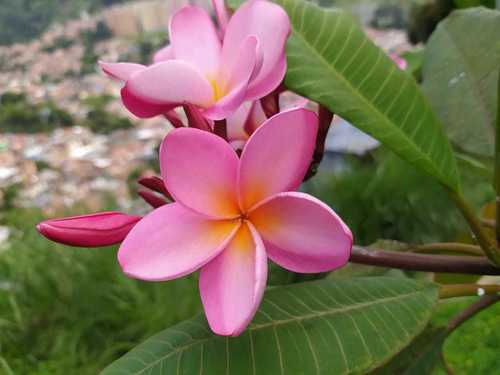
Mexican Plumeria
Plumeria rubra
The Mexican Plumeria is the crown jewel of the tropical backyard, famed for its waxy, kaleidoscopic blooms and an intoxicating fragrance that defines summer evenings. Whether it is playing host to iridescent moths or standing as a sculptural winter silhouette, this tree is a cornerstone of garden biodiversity.
Quick Identification
Size
Grows as a spreading tree or large shrub reaching 7–8 m (23–26 ft) in both height and width.
Colors
Flowers feature shades of white, yellow, pink, and deep red, often with contrasting centers; leaves are a rich, matte dark green.
Key Features
- Clusters of fragrant, five-petaled waxy flowers in a terminal spiral
- Thick, succulent-like greyish-green branches that are highly bifurcated
- Large, leathery lance-shaped leaves with prominent veins
- Copious milky-white sap visible if leaves or bark are damaged
When You’ll See Them
Loading activity data...
Behavior
The Mexican Plumeria is a deciduous masterpiece known for its dramatic seasonal transformation. Throughout the summer and autumn, it focuses its energy on producing dense clusters of blossoms that release a powerful fragrance, particularly at night. Interestingly, these flowers are deceptive; they produce no nectar but use their intense scent to lure Sphinx moths into a fruitless search for food, ensuring pollination through trickery.
During the cooler or drier winter months, the tree enters a dormant phase, dropping its large, leathery leaves to reveal a skeletal, sculptural frame. This thick-branched structure provides excellent perching spots for urban birds and lizards. In suburban environments, it is a sturdy, drought-tolerant resident that interacts with humans primarily through its ornamental beauty and the calming aroma it drifts through garden windows.
EverydayEarth exclusive
Camera Tips
To capture the true beauty of the Mexican Plumeria, focus your AI camera on the tips of the branches where the 'inflorescence' or flower clusters form. Because these trees are stationary, they provide a perfect opportunity for long-term time-lapse projects. Set your camera to take a photo every hour during the late spring to watch the transformation from blunt, leafless stalks to a lush canopy of vibrant blossoms.
If you want to capture wildlife, the Mexican Plumeria is a magnet for the Sphinx moth. Since these moths are most active at twilight and move with incredible speed, you will need a camera with a fast shutter speed or a high-quality infrared night vision mode. Position your camera approximately 3 feet away from a fresh bloom cluster, ensuring the lens is angled slightly upward to catch the moth hovering in mid-air as it investigates the flowers.
During the day, the large, flat leaves of the Plumeria act as perfect basking platforms for reptiles. If you have an AI-powered camera that triggers on movement, mount it about 5 feet up the trunk looking down toward the lower branches. This angle frequently captures lizards and tree frogs that utilize the thick, stable limbs as a highway between the ground and the safety of the upper canopy.
Lastly, consider the seasonal changes. In the winter, the bare, grey limbs create high-contrast silhouettes against the sky. Adjust your exposure settings to account for the bright background, as this is the best time to document backyard birds like hummingbirds or flycatchers that use the open branches as lookout posts before diving for insects.
Similar Species
Species that look similar or are commonly confused with Mexican Plumeria.
White Frangipani
Features blunt, rounded leaf tips and almost exclusively white flowers with a yellow eye.
Bridal Bouquet
Has unique spoon-shaped leaves and lacks the strong fragrance typical of the Mexican Plumeria.
Singapore Graveyard Flower
An evergreen variety with much glossier, dark green leaves and a more rounded petal shape.
Frequently Asked Questions
Record Mexican Plumeria at your habitat
Connect a camera to start building your own species record — AI identifies every visitor automatically.