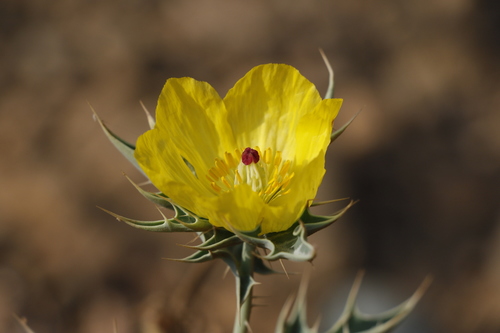
Mexican prickly poppy
Argemone mexicana
A resilient beauty of the sun-scorched earth, the Mexican prickly poppy combines delicate yellow blooms with a formidable armor of silver-veined spines. This hardy pioneer thrives where others cannot, turning dry roadsides into vibrant displays of golden light.
Quick Identification
Size
Stands 30–100 cm (1–3.3 ft) tall with flowers 5–7 cm (2–3 in) in diameter
Colors
Bright lemon-yellow petals with a cluster of golden-orange stamens; foliage is a dusty blue-green with prominent white veins
Key Features
- Large, butter-yellow flowers with a center of golden stamens
- Thistle-like, blue-green leaves with striking white veins
- Stems and seed pods covered in sharp, protective spines
- Bright yellow latex sap visible when the stem is broken
When You’ll See Them
Behavior
The Mexican prickly poppy is a resilient pioneer species, often the first plant to colonize disturbed ground, dry roadsides, and abandoned lots. Despite its delicate, paper-like flowers, it is a formidable survivor, using its dense covering of sharp spines to deter herbivores. It is famously drought-tolerant, thriving in poor, sandy soil where other plants would wither.
While it is poisonous to most grazing mammals due to toxic alkaloids, it plays a vital role in the ecosystem by providing a rich source of pollen for a variety of insects. In its native and naturalized ranges, it follows a diurnal cycle, with its blooms opening wide in the morning to greet the sun and closing or drooping slightly as evening approaches. It spreads primarily through its numerous small, black seeds which are housed in spiny capsules that burst open when mature.
EverydayEarth exclusive
Camera Tips
To capture the dramatic textures of the Mexican prickly poppy, set your camera at a low 'worm's eye' perspective, approximately 12 to 18 inches off the ground. This angle emphasizes the plant’s structural defenses—the spines and jagged leaf margins—against the sky, creating a powerful silhouette. Because this plant does not move, it is the perfect subject for time-lapse photography. Set your camera to take a photo every 5 to 10 minutes from dawn until noon to capture the mesmerizing unfurling of the yellow petals as they respond to the morning light.
If you are using an AI-powered camera to track wildlife, the Mexican prickly poppy serves as an excellent 'natural stage.' Position your camera about 2 to 3 feet away from a fresh bloom, focusing on the flower's center. This plant is a magnet for pollinators like honeybees, sweat bees, and hoverflies. By focusing on the flower, you can trigger high-quality macro-style shots of these insects as they forage for pollen. Ensure your shutter speed is high (at least 1/500s) to freeze the motion of fast-moving wings.
Lighting is crucial for this species. The white veins on the blue-green leaves are most prominent during the 'golden hours' of early morning or late afternoon. Midday sun can often wash out the pale yellow of the petals, so try to use a camera setting that slightly underexposes the shot to preserve the detail in the bright flowers. If your camera allows for focal zones, set the zone specifically on the seed pods late in the season to catch the moment a bird or a gust of wind triggers the release of the seeds.
Similar Species
Species that look similar or are commonly confused with Mexican prickly poppy.
Frequently Asked Questions
Record Mexican prickly poppy at your habitat
Connect a camera to start building your own species record — AI identifies every visitor automatically.