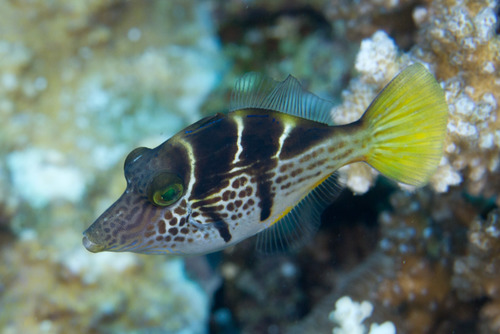
Mimic Filefish
Paraluteres prionurus
The Mimic Filefish is a master of underwater deception, perfectly imitating a toxic pufferfish to ward off predators. Found throughout the Indo-Pacific, this clever reef dweller is a favorite for underwater photographers seeking to document the marvels of evolutionary mimicry.
Quick Identification
Size
A small reef dweller reaching a maximum length of 11 cm (4.3 inches)
Colors
Creamy white body with four distinctive dark brown to black 'saddles' across the back; yellowish fins and subtle spotting on the lower body
Key Features
- Four dark brown/black saddles along the dorsal surface
- Retractable dorsal spine used for wedging into crevices
- Mimics the poisonous Saddled Pufferfish (Canthigaster valentini)
- Lacks the poisonous skin and flesh of its pufferfish double
- Continuous dorsal and anal fins located far back on the body
When You’ll See Them
Geographic range
Where Does the Mimic Filefish Live?
Native to the vast Indo-Pacific region, the Mimic Filefish is a master of disguise found swimming through the warm, tropical waters of the Indian and Pacific Oceans. Its core territory stretches from the eastern coast of Africa and the Red Sea across to the Line Islands and the Tuamotu Archipelago. Divers and coastal observers frequently spot them in the rich coral ecosystems of Australia’s Great Barrier Reef, the Philippines, Indonesia, and as far north as southern Japan.
Basemap © OpenStreetMap contributors
Behavior
The Mimic Filefish is one of the most famous examples of Batesian mimicry in the ocean. It shares a nearly identical color pattern and body shape with the Saddled Pufferfish, a species known by predators to be highly toxic. By looking like a dangerous meal, the harmless Mimic Filefish enjoys a degree of protection from larger reef predators. While the pufferfish moves with a stiff, jerky motion, the filefish can be distinguished by its slightly more fluid swimming style and its ability to raise a long, slender dorsal spine.
Unlike many other filefish that are shy and elusive, this species is relatively bold because it relies on its 'toxic' disguise. They are generally solitary or found in pairs, often seen hovering just above the reef substrate. When threatened, they don't rely on speed; instead, they retreat into coral branches or crevices, using their dorsal spine to lock themselves securely in place so they cannot be easily pulled out by a predator.
EverydayEarth exclusive
Camera Tips
Capturing the Mimic Filefish on an underwater AI camera requires a focus on stationary reef locations rather than open water. These fish are 'homebodies' that tend to stay near specific coral heads or rocky outcroppings. For the best results, mount your camera on a weighted tripod or a stationary reef clamp (where environmentally safe) approximately 1 to 2 feet away from a known grazing site. Because they are small, a macro or close-focus lens setting is essential to distinguish their markings from their toxic pufferfish lookalikes.
Lighting is the biggest challenge when documenting this species. As you move deeper, the vibrant blacks and yellows of their 'saddles' can wash out into a dull grey. Use powerful external strobes or high-CRI video lights to bring back the natural contrast. Position your lights at 45-degree angles to the camera to avoid backscatter from particles in the water. This will highlight the filefish's unique skin texture and the subtle differences in its fin structure compared to a pufferfish.
Timing is everything when observing mimicry. Set your camera to record during the middle of the day when sunlight is at its peak, as this is when the filefish is most active and its disguise is most effective. Look for 'cleaning stations' or areas with high algae growth. If you can find a Saddled Pufferfish, stay nearby—the Mimic Filefish is often found in the same vicinity, trailing the toxic puffer to reinforce the illusion. High-frame-rate settings (60fps or higher) will help you catch the rapid movement of their transparent fins.
Frequently Asked Questions
Record Mimic Filefish at your habitat
Connect a camera to start building your own species record — AI identifies every visitor automatically.