Mānuka
Leptospermum scoparium
A resilient pioneer of the southern wilderness, Mānuka is more than just a source of world-class honey. Its delicate blossoms and prickly leaves create a bustling micro-ecosystem that brings your backyard to life.
Quick Identification
Size
Varies from a prostrate shrub to a small tree, typically 2–8 meters (6.5–26 feet) in height.
Colors
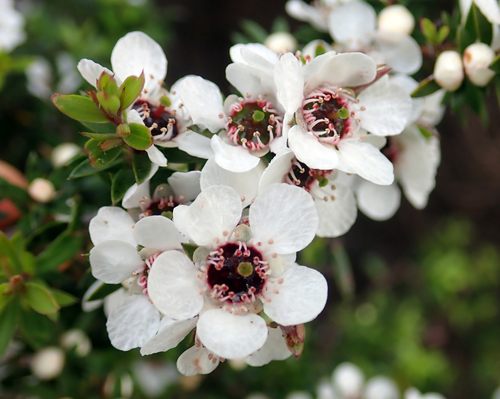
Dark green to brownish-green foliage; flowers are usually vibrant white, but can range to pale pink or deep crimson in cultivars.
Key Features
- Small, narrow leaves that are prickly to the touch
- Rough, flaky bark that peels in long thin strips
- Five-petaled flowers with a prominent dark central disc
- Hard, woody seed capsules that remain on the plant year-round
When You’ll See Them
Behavior
Mānuka is a hardy pioneer species, often the first plant to colonize land after a disturbance like a fire or landslide. It is remarkably resilient, capable of thriving in a wide range of environments from coastal wetlands to subalpine slopes. While it doesn't move in the traditional sense, it acts as a 'nursery plant' for the forest, providing the necessary shade and shelter for slower-growing native trees to establish themselves.
Ecologically, Mānuka is a hive of activity. Its flowers produce a high-sugar nectar that is a primary food source for native bees, flies, and beetles. This relationship is the foundation of the famous mānuka honey industry. In a backyard setting, Mānuka provides excellent cover for small birds and acts as a host for various specialist insects, including the mānuka beetle and several species of stick insect.
EverydayEarth exclusive
Camera Tips
To capture the true essence of Mānuka on your trail camera, focus on 'Plant-Lapse' photography or wildlife interaction. If your camera has a time-lapse mode, set it to take a photo every 30 minutes during the peak flowering months of December and January. This allows you to watch the spectacular transition from tight green buds to a canopy of white blossoms. Ensure the camera is mounted on a very stable post rather than a branch, as Mānuka limbs are flexible and will sway in the wind, leading to blurry shots or false triggers.
For those interested in the wildlife attracted to the tree, position your camera about 3-5 feet away from a cluster of flowers. Use a high-sensitivity setting to catch the rapid movements of pollinators. Because the flowers are small, lighting is crucial; try to angle your camera so it is side-lit by the morning or afternoon sun. This creates shadows that define the shape of the petals and the texture of the leaves, making your images look more professional and easier for AI identification to process.
Don't ignore the trunk! The flaky, papery bark of older Mānuka trees is a favorite hiding spot for geckos and invertebrates. Mount a camera vertically against a neighboring tree or post, focused on a section of the Mānuka trunk. If you use infrared (IR) at night, you might capture the rare sight of native moths or even a wētā exploring the crevices of the bark. Set your video length to 10-15 seconds to observe these slower-moving creatures without filling up your SD card.
Lastly, if you have a variety of Mānuka with particularly vibrant flowers, you can attract 'honey-eater' birds like the Tūī or Bellbird. Place your camera at a height of about 1.5 to 2 meters, aiming at the top third of the bush where the flowers are most dense. These birds are fast, so a trigger speed of 0.3 seconds or faster is highly recommended to catch them mid-sip.
Frequently Asked Questions
Record Mānuka at your habitat
Connect a camera to start building your own species record — AI identifies every visitor automatically.