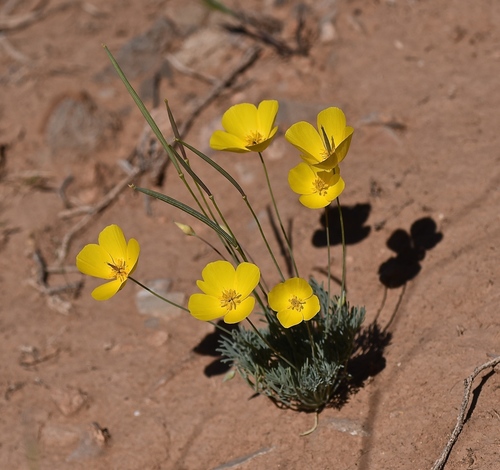
Mojave Poppy
Eschscholzia glyptosperma
A golden treasure of the arid Southwest, the Mojave Poppy turns barren desert washes into a sea of brilliant yellow after spring rains.
Quick Identification
Size
Stands 2 to 10 inches (5 to 25 cm) tall; flowers are 0.8 to 2 inches (2 to 5 cm) in diameter.
Colors
Brilliant lemon-yellow to golden petals; basal foliage is a dusty blue-green or glaucous gray.
Key Features
- Cup-shaped lemon-yellow flowers with four petals
- Leafless stems (scapes) rising from a basal tuft of leaves
- Finely dissected, lacy blue-green foliage
- Flowers close tightly at night or during overcast weather
When You’ll See Them
Behavior
The Mojave Poppy is a resilient desert annual that follows a 'bloom and bust' strategy. It spends most of its life as a seed buried in the parched desert soil, waiting for the perfect sequence of winter rains to trigger germination. Once it emerges, it grows rapidly to take advantage of the brief spring moisture window before the intense summer heat returns.
A fascinating behavior of this poppy is its nyctinastic movement. The petals are highly sensitive to light and temperature; they unfurl in the morning sun to invite pollinators like solitary bees and then twist shut as the sun sets or if a storm approaches. This protects the delicate reproductive organs and keeps the pollen dry and viable.
EverydayEarth exclusive
Camera Tips
Capturing the Mojave Poppy with an AI-powered trail camera requires a different approach than moving wildlife. To get the best results, mount your camera on a low-profile stake or a ground-level tripod. The camera should be positioned just 6 to 12 inches off the ground, angled slightly upward to capture the interior of the yellow cups against the vast desert sky. Because these plants are small, a camera with a good macro focus or a short minimum focal distance is essential for crisp detail.
The most spectacular footage comes from using the time-lapse mode. Set your camera to take a photo every 5 to 10 minutes from sunrise to mid-afternoon. When stitched together, this reveals the dramatic 'waking up' process as the petals unfurl. Ensure the camera is weighted down or securely staked; the desert wind can be fierce, and even slight camera shake will ruin a time-lapse of a delicate flower.
Lighting is your biggest challenge and your best friend. The harsh midday desert sun can wash out the brilliant yellow of the petals. Aim for 'golden hour' shots—the hour after sunrise or before sunset—to get a warm, glowing effect. If your camera allows for exposure adjustment, slightly underexposure can help preserve the rich color of the petals and prevent the highlights from 'blowing out' in the bright sun.
Finally, consider the background. Position the camera so the poppies are framed against a contrasting element, like a dark volcanic rock or a creosote bush. This makes the bright gold pop visually. If you are using an AI camera triggered by motion, be aware that wind-blown foliage might cause 'false triggers,' so adjusting the sensitivity or using a dedicated time-lapse setting is highly recommended for this species.
Similar Species
Species that look similar or are commonly confused with Mojave Poppy.
Frequently Asked Questions
Record Mojave Poppy at your habitat
Connect a camera to start building your own species record — AI identifies every visitor automatically.