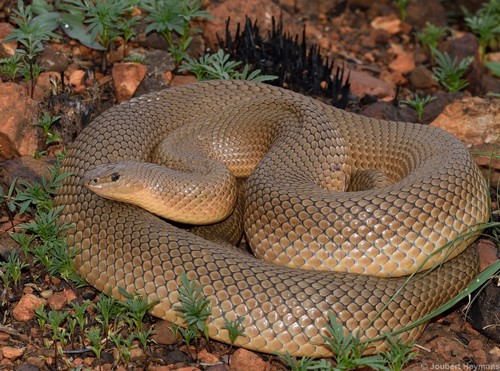
Mole Snake
Pseudaspis cana
The Mole Snake is Southern Africa's premier underground hunter, a non-venomous powerhouse that keeps rodent populations in check. With their distinctive pointed snouts and muscular bodies, they are a fascinating example of specialized evolution in the reptile world.
Quick Identification
Size
Typically 1.4 to 2 metres (4.5 to 6.5 feet) in length; robust specimens can weigh over 1 kg (2.2 lbs)
Colors
Adults vary from jet black, charcoal, and dark brown to light tan or brick red; juveniles have bold dark spots and zig-zags
Key Features
- Pointed, cone-shaped snout designed for digging
- Small head that is not distinct from the thick, muscular neck
- Smooth, shiny scales with a very robust, cylindrical body
- Round pupils and a lack of heat-sensing pits
When You’ll See Them
Geographic range
Where Does the Mole Snake Live?
Native to the vast landscapes of Southern and Eastern Africa, the Mole Snake thrives across a diverse range of environments. Its core territory stretches from the southern tip of South Africa through Namibia, Botswana, and Zimbabwe, extending northwards into parts of Mozambique, Angola, and even high-altitude regions of Kenya and Tanzania. These snakes are particularly fond of regions with sandy soils, which allow them to exhibit their remarkable burrowing abilities and hunt their namesake prey.
Basemap © OpenStreetMap contributors
Behavior
The Mole Snake is a powerful, non-venomous constrictor that spends much of its life patrolling for rodents. Despite their lack of venom, they are known for their bold and defensive nature; when threatened, they will hiss loudly and can deliver a painful bite with their sharp, backwards-curving teeth. They are primarily diurnal, meaning they are active during the day, though they are often found underground in abandoned animal burrows.
In many Southern African suburbs, they are considered a 'gardener's friend.' They are highly efficient hunters that keep populations of destructive moles and rats in check. While they are solitary animals, they are frequently seen during the spring mating season when males become more active and mobile in their search for females. Unlike many other snakes, Mole Snakes are viviparous, giving birth to large litters of live young—sometimes as many as 30 to 50 at once.
EverydayEarth exclusive
Camera Tips
To capture a Mole Snake on camera, placement is everything. These snakes are ground-dwellers that rarely climb, so your camera must be positioned no more than 10-15 centimeters (4-6 inches) off the ground. Aim the lens along 'natural highways' like the edges of garden walls, fence lines, or the transition zone between mown grass and thick brush. Since they are ectothermic (cold-blooded), they may not reliably trigger standard PIR motion sensors; setting your camera to a 'Time Lapse' mode with a 1-minute interval during daylight hours is a far more effective strategy for capturing their movement.
Look for active rodent burrows or mole mounds in your yard, as Mole Snakes frequent these areas to hunt. If you have a sandy patch of soil, check for thick, undulating tracks—a clear sign that a Mole Snake is nearby. They are most active on warm, sunny mornings after a period of rain, as this brings their prey to the surface. Position your camera facing north or south to avoid 'sun flare' on the lens during the peak morning and afternoon activity periods.
Avoid using bait, as these snakes hunt active, live prey through scent and vibration. Instead, focus on creating a 'funnel' using a fallen log or a row of bricks to guide the snake directly in front of the camera lens. Use a high-speed trigger setting if available, as despite their heavy build, they can move surprisingly quickly when crossing open ground. Because they are often quite large, ensure your camera has a wide enough field of view to capture the entire body length rather than just a blur of scales.
Frequently Asked Questions
Record Mole Snake at your habitat
Connect a camera to start building your own species record — AI identifies every visitor automatically.