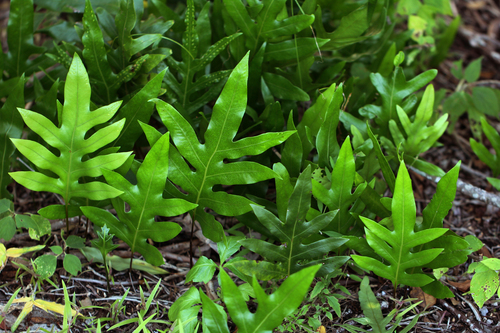
monarch fern
Microsorum scolopendria
A hardy tropical icon, the monarch fern transforms garden floors with its deeply lobed, leathery fronds and a sweet, musk-like fragrance that evokes the spirit of the South Pacific.
Quick Identification
Size
Fronds typically range from 20 to 90 cm (8 to 35 inches) long and up to 30 cm (12 inches) wide.
Colors
Bright, glossy emerald to lime green fronds; mature undersides feature distinctive orange to rust-colored circular spore cases (sori).
Key Features
- Deeply lobed, leathery fronds with a 'centipede' shape
- Raised, wart-like sori visible on the upper surface of the leaves
- Creeping, dark brown or black rhizomes that spread across the ground or trees
- Characteristic musk-like scent when the foliage is crushed.
When You’ll See Them
Behavior
The monarch fern is a hardy and adaptable plant that exhibits two primary growth habits: it can grow as a terrestrial plant on the forest floor or as an epiphyte, clinging to the trunks of trees and rocky outcrops. Unlike many delicate ferns, the monarch fern is known for its tough, leathery texture, which allows it to withstand slightly drier conditions and coastal salt spray. It spreads relatively quickly via its thick, creeping rhizomes, eventually forming dense mats of vibrant green foliage.
In backyard settings, this fern is often used as a lush groundcover or a decorative 'filler' in tropical landscapes. While it doesn't move or interact like an animal, it creates a vital micro-habitat for small garden creatures. Skinks, geckos, and various beneficial insects often seek shelter within its dense, overlapping fronds, while the plant itself reacts to the environment by releasing its signature 'maile' scent during periods of high humidity or after rainfall.
EverydayEarth exclusive
Camera Tips
To capture the best images of a monarch fern with your AI-powered camera, focus on the unique geometry of its fronds. Position your camera at a low angle, roughly 10 to 15 inches from the ground, to highlight the way the fronds emerge from the creeping rhizomes. If you are looking to document the plant's 'warty' appearance, aim the lens at the underside of a mature frond where the orange sori are most prominent. High-resolution macro settings are ideal for capturing the intricate texture of these spore cases.
Setting your camera to a time-lapse mode is the most rewarding way to observe this species. Over several weeks, you can record the 'fiddleheads' or croziers as they slowly uncurl into full fronds. This is best done during the rainy season when growth is most rapid. Ensure the camera is mounted on a stable stake to prevent wind shake, as the large lobes of the monarch fern act like sails in a breeze and can cause motion-blur in standard trigger modes.
Because the monarch fern is a hub for backyard biodiversity, use it as a 'stage' for capturing animal activity. Place your camera near a cluster of ferns where the foliage meets a garden path or tree trunk. This is a prime location for spotting lizards and insects that use the fern for shade and hunting. Use a 'motion-trigger' setting with a high sensitivity to catch the fast movements of skinks darting between the lobes.
For the best lighting, avoid the harsh midday sun, which can wash out the deep greens of the plant. The 'golden hours' of early morning or late afternoon provide soft, directional light that emphasizes the raised texture of the 'warts' on the leaves. If your camera has adjustable white balance, set it to 'cloudy' to enhance the rich, tropical saturation of the emerald fronds.
Frequently Asked Questions
Record monarch fern at your habitat
Connect a camera to start building your own species record — AI identifies every visitor automatically.