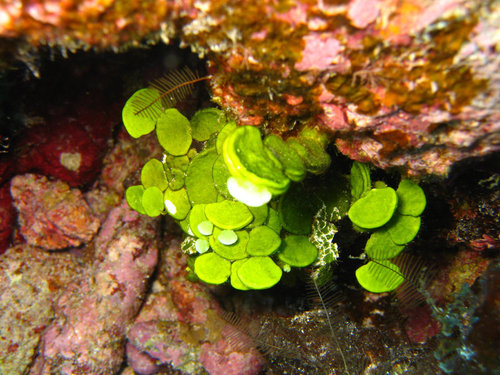
money plant
Halimeda discoidea
Meet the architect of tropical beaches. The Money Plant is a stunning, coin-shaped algae that builds coral reefs and creates the white sands of paradise.
Quick Identification
Size
Individual segments 1–2.5 cm (0.4–1 in) in diameter; clumps typically reach 10–25 cm (4–10 in) in height
Colors
Vibrant emerald green to deep olive green; bleached white when dead
Key Features
- Flat, coin-shaped calcified segments
- Flexible, non-calcified joints between segments
- Bushy, fan-like growth pattern
- Chalky, brittle texture due to internal calcium carbonate
When You’ll See Them
Geographic range
Where Does the money plant Live?
Where Does the Money Plant Live? The Money Plant is a quintessential resident of the world's tropical oceans, favoring the crystal-clear, warm waters of the Indo-Pacific and the Caribbean basins. It is most commonly found anchored to coral reefs or nestled in sandy lagoons from the Florida Keys and the Bahamas through the West Indies and across to the shores of Hawaii and Australia's Great Barrier Reef. This species thrives in high-light environments, usually occupying the shallow sun-drenched zones where photosynthesis is most efficient.
Basemap © OpenStreetMap contributors
Behavior
During the day, the Money Plant is an energetic producer, positioning its chloroplasts near the surface of its segments to maximize sunlight absorption. Interestingly, researchers have observed that some Halimeda species can actually withdraw their green pigments deeper into their skeletons at night or during periods of intense stress to protect their cellular machinery. While it doesn't move in the traditional sense, its segments sway gracefully with the ebb and flow of the tide, providing a micro-habitat for tiny marine invertebrates.
EverydayEarth exclusive
Camera Tips
Lighting is the biggest challenge when photographing marine life. In shallow water, natural light is often sufficient, but the red end of the spectrum is quickly absorbed by the water, making the plant look more blue than green. Using a red filter on your camera lens or a high-CRI (Color Rendering Index) underwater video light will help restore the Money Plant's natural, vibrant green hue. Aim for mid-day when the sun is directly overhead for the best clarity and to capture the 'cathedral' effect of light rays piercing the water.
Since the Money Plant is stationary, it is the perfect subject for time-lapse photography. Set your camera to take a photo every 30 seconds for several hours during a tidal shift. This will capture the mesmerizing dance of the segments as they sway in the current and may reveal shy marine visitors like nudibranchs, small crabs, or grazing surgeonfish that inhabit the clumps. Ensure your camera is securely weighted or anchored to a rock (without damaging the reef) so that the surge doesn't move your frame.
Maintenance is crucial for long-term deployments. Saltwater is highly corrosive and can cause 'salt creep' on the lens, which blurs the image. If you are leaving a camera for several days, ensure the housing is treated with an anti-fog insert and the lens is wiped clean of any biofilm or algae growth that can accumulate quickly in tropical waters. A quick rinse with fresh water after every deployment will extend the life of your equipment significantly.
Frequently Asked Questions
Record money plant at your habitat
Connect a camera to start building your own species record — AI identifies every visitor automatically.