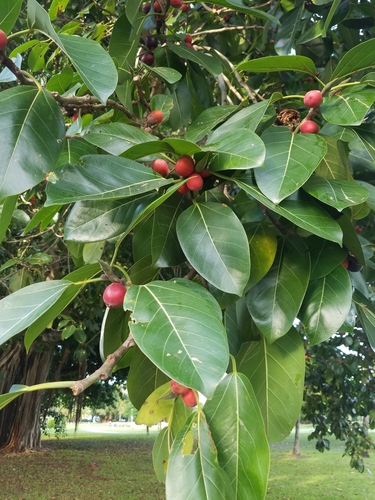
Mountain Fig
Ficus altissima
The Mountain Fig is a sprawling, silvery giant that defines the tropical skyline. From its strangling roots to its massive fruiting canopy, this 'Council Tree' acts as a vibrant skyscraper for hundreds of species of birds and mammals.
Quick Identification
Size
Height up to 100 feet (30 meters); canopy spread often exceeding 60 feet (18 meters)
Colors
Smooth light grey to silvery bark; dark green leathery leaves with pale yellow veins; fruit ripens from green to bright orange or red
Key Features
- Massive buttress roots and hanging aerial roots
- Thick, oval leathery leaves up to 10 inches long
- Smooth, silver-grey bark that remains unwrinkled even in age
- Stalkless paired figs that turn bright orange-red
When You’ll See Them
Behavior
The Mountain Fig, also known as the Council Tree, is a magnificent hemiepiphyte, often beginning its life as a 'strangler.' It starts when a seed is dropped by a bird into the canopy of a host tree. The young fig sends long, rope-like aerial roots down to the forest floor. Once these roots touch the ground, they thicken and eventually fuse together, surrounding the host tree in a wooden lattice that can eventually lead to the host's demise as the fig claims the sunlight and space.
As it matures, the Mountain Fig becomes a keystone species within its ecosystem. It doesn't move in the traditional sense, but it 'behaves' as a massive biological hub. Its massive canopy provides a cooling microclimate, while its aggressive root system stabilizes the soil. It maintains a symbiotic relationship with specific agaonid wasps for pollination, a complex biological dance where the wasps live and breed inside the figs themselves.
In human-dominated landscapes, these trees are often the centerpieces of village squares or urban parks. While they are stationary, they are never 'quiet'; they are constantly interacting with the environment by transpiring large amounts of water and providing a 24/7 buffet for local wildlife during fruiting cycles.
EverydayEarth exclusive
Camera Tips
To effectively capture the Mountain Fig on a trail camera, you must think of the tree as a destination rather than a single subject. Because of its massive scale, a standard close-up will only show bark. Instead, mount your camera 15-20 feet away from the main trunk using a wide-angle lens setting to capture the impressive architecture of the buttress roots. These roots create natural 'corridors' that ground-dwelling wildlife like porcupines, monitor lizards, or small cats use for cover, making the base of the tree an ideal spot for motion-activated triggers.
If your goal is to document the birds and arboreal mammals that the Mountain Fig attracts, you'll need to get the camera off the ground. Use a specialized tree mount or a long ladder to place the camera 10-15 feet high, overlooking a cluster of ripening figs. These fruit clusters are natural 'baits.' During the peak fruiting season, you can capture spectacular footage of hornbills, bulbuls, and even monkeys. Set your camera to 'Burst Mode' to catch the fast-paced action of birds landing and taking off from the branches.
Lighting can be a challenge under the Mountain Fig's dense canopy. The interior of the tree is often significantly darker than the surrounding area, which can trick some cameras into staying in infrared mode even during the day. If your camera allows, manually adjust the exposure compensation to +0.5 or +1.0 to bring out the detail in the dark green leaves and grey bark. For a unique perspective, try a time-lapse setting—one photo every hour for a month—to see how the aerial roots slowly descend toward the earth.
Don't forget the night shift! Many fruit-eating bats and civets visit the Mountain Fig under the cover of darkness. Ensure your camera's black flash (no-glow) is enabled so as not to spook these sensitive visitors. Position the camera facing a clear 'opening' in the branches where animals are likely to land. Since the tree's bark is smooth, use a padded strap to avoid damaging the tree and to prevent the camera from slipping during heavy tropical rains.
Frequently Asked Questions
Record Mountain Fig at your habitat
Connect a camera to start building your own species record — AI identifies every visitor automatically.