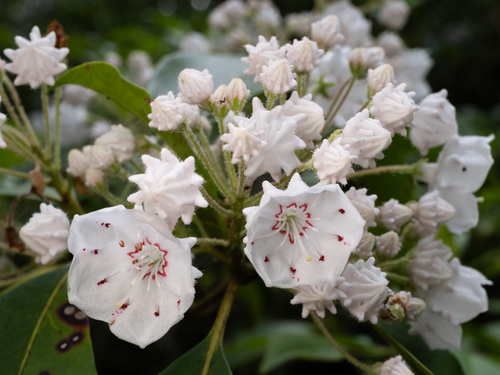
mountain laurel
Kalmia latifolia
Often called the 'Calico Bush,' Mountain Laurel transforms eastern forests into a sea of pink and white every spring. With its spring-loaded petals and evergreen leaves, it is a master of both defense and attraction.
Quick Identification
Size
Typically 7 to 15 feet (2.1–4.5 m) tall and wide, though exceptionally old specimens can reach heights of 30 feet (9.1 m).
Colors
Glossy dark green leaves; flowers are white to light pink with distinct purple-pink interior markings and dots.
Key Features
- Cup-shaped flowers with ten distinct pockets
- Symmetrical, hexagonal-shaped flower buds
- Leathery, elliptical evergreen leaves
- Gnarled, twisting multi-stemmed trunks
When You’ll See Them
Behavior
Mountain laurel is famous for its unique and dramatic pollination strategy. The plant’s stamens are held under high tension within small pockets in the petals. When an insect, such as a bumblebee, lands on the flower to seek nectar, the weight or movement triggers the stamen to snap upward like a catapult. This explosive action douses the insect in pollen, which is then carried to the next flower, ensuring efficient cross-pollination.
As an evergreen, this species provides critical year-round structural cover for a variety of backyard wildlife, though it is famously toxic to most mammals if ingested. It contains grayanotoxins, which serve as a powerful chemical defense against herbivores. While deer may occasionally browse the tips during a particularly lean winter, most animals have learned to steer clear of the foliage, making it a resilient fixture in the landscape.
EverydayEarth exclusive
Camera Tips
To capture the mountain laurel in its full glory, switch your camera to time-lapse mode during the peak blooming window of late spring. Position the camera on a sturdy tripod or mount it to a nearby tree facing a cluster of unopened, origami-like buds. A capture interval of one photo every 20 to 30 minutes during daylight hours will produce a stunning video of the blossoms unfurling over the course of several days.
If your goal is to record the "explosive" pollination mechanism, you will need a camera capable of high-speed video or a very fast trigger speed. Focus your lens on a single, freshly opened flower cluster from a distance of about 12 to 18 inches. This macro-style setup is ideal for capturing bumblebees as they trigger the spring-loaded stamens. Ensure you have plenty of natural light, as the high shutter speed required to freeze the stamen's movement needs a bright environment.
Be mindful of the mountain laurel's waxy, evergreen leaves when using infrared (IR) flash at night. These leaves are highly reflective and can cause a "white-out" effect in your nighttime photos, making the plant look like a glowing blob. To prevent this, angle your camera at a 45-degree side-angle to the foliage rather than pointing it directly at the flat surface of the leaves. You can also place a small piece of semi-transparent tape over a portion of the IR LED to soften the flash intensity.
Don't just focus on the flowers; the dense, gnarled thickets at the base of the plant are high-traffic areas for wildlife. Place a trail camera at a low angle (6-12 inches off the ground) pointing into the "tunnel" created by the twisting branches. These areas, often called "laurel hells," are favorite nesting and hiding spots for birds like the Black-throated Blue Warbler and various small mammals that use the evergreen cover to evade predators throughout the winter.
Similar Species
Species that look similar or are commonly confused with mountain laurel.
Frequently Asked Questions
Record mountain laurel at your habitat
Connect a camera to start building your own species record — AI identifies every visitor automatically.