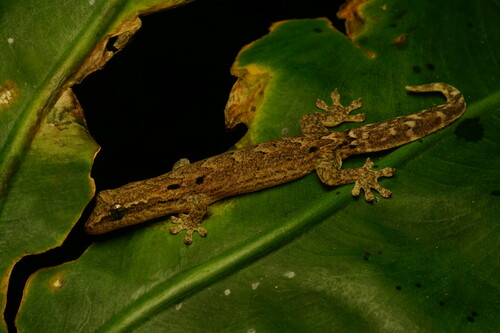
Mourning Gecko
Lepidodactylus lugubris
Meet the world-traveling, all-female lizard known for its social chirps and chevron stripes. The Mourning Gecko is a master of adaptation, turning backyard porches into its own personal hunting ground.
Quick Identification
Size
8.5 to 10 cm (3.3 to 4 inches) in total length; weight approximately 2 to 4 grams
Colors
Cream, tan, or light brown with distinctive dark brown chevron markings; pale cream to yellowish belly
Key Features
- Dark 'W' or chevron-shaped markings along the back
- Vertical pupils with golden-brown irises and no eyelids
- Toepads with expanded lamellae and small claws
- Slightly flattened, smooth-scaled tail
When You’ll See Them
Geographic range
Where Does the Mourning Gecko Live?
The Mourning Gecko is native to the vast coastal regions and island chains of the Indo-Pacific, including Southeast Asia and the Pacific Islands. Due to their ability to stow away in cargo and their resilient eggs, they have been introduced to a massive global range that now includes Hawaii, Central and South America, the Galapagos Islands, and parts of Australia and the Seychelles. They are one of the most widely distributed lizard species in the world, thriving anywhere with a consistently warm, tropical, or subtropical climate.
Basemap © OpenStreetMap contributors
Behavior
Mourning geckos are a fascinating biological anomaly, being a nearly all-female species that reproduces through parthenogenesis. This means females produce fertile eggs without the need for males, effectively creating clones of themselves. Because of this, they can colonize new habitats with incredible speed, as a single individual is enough to start a whole new population. Despite their solitary reproductive nature, they are highly social and are often found living in small, loose colonies where they establish a pecking order through physical displays and vocalizations.
These geckos are quite vocal, frequently emitting a series of rapid 'chik-chik-chik' sounds to communicate with others or defend their territory. While they are primarily nocturnal, they are bold around humans and are commonly seen hunting insects near outdoor light fixtures or inside houses. Their movement is jerky and fast, and they are excellent climbers capable of scale-shifting across smooth glass or ceilings with ease.
EverydayEarth exclusive
Camera Tips
To capture high-quality footage of Mourning Geckos, your best bet is to target artificial light sources. Outdoor porch lights, security LEDs, or window sills where interior light spills out are natural 'supermarkets' for these geckos because they attract the moths and flies the lizards hunt. Position your camera about 12 to 24 inches away from these surfaces. If your camera has a macro mode or adjustable focus, ensure it is set for close-range work, as these small reptiles can easily appear as blurry smudges on a standard wide-angle lens.
While they are skilled hunters, Mourning Geckos are also suckers for sweets. You can lure them into a specific frame by placing a small dab of mashed banana, mango puree, or even a drop of honey on a fence post or tree trunk. This will often keep them stationary long enough for your camera to trigger and record a clear image. Because they are active after dark, ensure your camera’s infrared (IR) night vision is functioning correctly. If you find the IR flash is 'washing out' the gecko due to its light-colored skin, try angling the camera slightly to the side rather than head-on.
Look for communal egg-laying sites to find consistent activity. They often tuck their sticky, pea-sized eggs into narrow cracks, behind shutters, or under the bark of trees. Monitoring these areas with a time-lapse setting can capture interesting social interactions, such as the 'arch-back' display used when two females are determining dominance. Since these geckos are small and cold-blooded, traditional PIR sensors may struggle to detect them; use a 'motion zone' video trigger if your AI camera supports it for better results.
Frequently Asked Questions
Record Mourning Gecko at your habitat
Connect a camera to start building your own species record — AI identifies every visitor automatically.