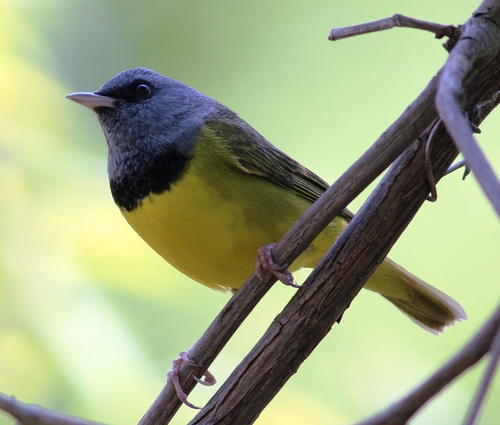
Mourning Warbler
Geothlypis philadelphia
A hidden gem of the undergrowth, the Mourning Warbler is a vibrant neotropical migrant known for its striking slate-grey hood and secretive personality. Hard to spot but easy to love, this songbird thrives in the densest thickets of North America.
Quick Identification
Size
Length: 10-15 cm (3.9-5.9 in); Wingspan: 19-22 cm (7.5-8.7 in); Weight: 11-15 g (0.4-0.5 oz)
Colors
Olive-green upperparts and bright yellow underparts. Males feature a distinct slate-grey hood with a black 'mourning' patch on the chest. Females and immatures have a lighter grey-brown hood and lack the black chest patch.
Key Features
- Grey hood contrasting with yellow belly
- Black smudged 'veil' on the male's upper chest
- Lack of a complete white eye ring (unlike similar species)
- Pinkish legs and a relatively short tail
When You’ll See Them
Geographic range
Where Does the Mourning Warbler Live?
The Mourning Warbler is a native of the North American continent, breeding primarily across the boreal forests of Canada and the northern United States, from the Great Lakes region to the Atlantic coast. As a neotropical migrant, it travels south through the eastern and central U.S. to reach its wintering grounds in Central America and northwestern South America. You will most often find them in countries like Costa Rica, Panama, and Colombia during the winter months, where they inhabit humid scrub and forest borders.
Basemap © OpenStreetMap contributors
Behavior
During the breeding season, males become slightly more visible as they choose perches just high enough to project their rhythmic, rolling song across their territory. However, at the first sign of an intruder or human presence, they typically dive back into the safety of the thickets. They are primarily solitary birds, though they may occasionally join mixed-species foraging flocks during their long migratory journeys between the Americas.
EverydayEarth exclusive
Camera Tips
Water is a much more effective lure for this species than food. Mourning Warblers are unlikely to visit traditional seed or suet feeders, but they are highly attracted to the sound of moving water. A ground-level birdbath with a solar-powered dripper or a small stone fountain will often entice them out of hiding for a bath or a drink. Position your camera about 3 to 5 feet from the water source to ensure the bird fills enough of the frame while staying within the camera's focal range.
If you are setting up in a backyard, avoid the urge to 'clean up' completely. Leaving a corner of your property with tall grass, briars, or raspberry bushes provides the exact 'edge' habitat they crave. In early autumn, they are particularly attracted to native berry-producing shrubs. Pointing your camera toward these natural food sources during the late August and September migration window can result in stunning footage.
Finally, use high-resolution video settings or a multi-shot burst mode. The identifying 'mourning' patch on the male's throat can be difficult to see if the bird is moving; video allows you to scrub through the frames to find the exact moment the light hits the chest, confirming the species identification. Early morning light is the best time for recording, as the soft light prevents the bright yellow belly from being overexposed in your shots.
Similar Species
Species that look similar or are commonly confused with Mourning Warbler.
MacGillivray's Warbler
Very similar but features prominent white crescents above and below the eye; found primarily in Western North America.
Connecticut Warbler
Slightly larger with a complete, bold white eye ring and a tendency to walk rather than hop.
Common Yellowthroat
Males have a sharp black 'bandit mask' rather than a full grey hood, and females lack the distinct greyish head coloring.
Frequently Asked Questions
Record Mourning Warbler at your habitat
Connect a camera to start building your own species record — AI identifies every visitor automatically.