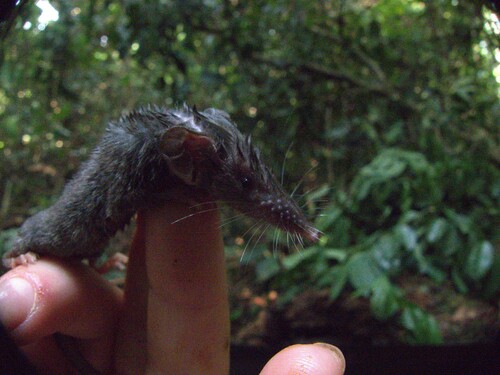
mouse-tailed shrew
Crocidura muricauda
A miniature marvel of the West African rainforest, the mouse-tailed shrew is famous for a tail that stretches longer than its own body. This high-energy hunter is a ghost of the leaf litter, rarely seen but vital to the forest floor ecosystem.
Quick Identification
Size
Body length 2.2–3.1 in (55–80 mm); tail length 2.4–3.5 in (60–90 mm); weight approx. 0.2–0.4 oz (6–12 g)
Colors
Uniform dark charcoal grey to chocolate brown fur with slightly paler grey underparts; tail is dark and nearly hairless.
Key Features
- Extremely long tail, often exceeding the length of the body
- Long, pointed snout with highly sensitive whiskers
- Tiny eyes and ears partially concealed by soft, velvety fur
- Dainty, five-toed feet built for scurrying through leaf litter
When You’ll See Them
Geographic range
Where Does the mouse-tailed shrew Live?
The mouse-tailed shrew is a specialist of the Upper Guinean forest block in West Africa. Its native range is concentrated in the lush, tropical belts of Sierra Leone, Guinea, Liberia, Ivory Coast, and Ghana. Within these countries, it is strictly associated with lowland rainforest environments where the canopy provides the consistent moisture and shade it requires to thrive.
Basemap © OpenStreetMap contributors
Behavior
The mouse-tailed shrew is a high-octane insectivore that lives life in the fast lane. Due to an incredibly high metabolic rate, this shrew is almost constantly on the move, darting through the leaf litter in search of its next meal. It is primarily nocturnal, using its exceptional sense of smell and sensitive whiskers (vibrissae) to navigate the pitch-black forest floor where its eyesight is of little use.
While solitary and territorial, these shrews are vocal and can produce high-pitched squeaks when encountering others or feeling threatened. They are master tunnelers, often utilizing the narrow gaps between tree roots and fallen branches to stay hidden from predators like owls and snakes. Their behavior is characterized by sudden, jerky movements and a constant twitching of the nose as they sample the air for prey.
EverydayEarth exclusive
Camera Tips
Capturing a mouse-tailed shrew on a trail camera is a badge of honor for any backyard wildlife enthusiast. Because of their tiny stature, you must place your camera at ground level. Dig a small depression or use a low-profile mount so the lens is no more than 2-3 inches off the ground. Aiming the camera along a 'runway'—such as the side of a large log or a natural clearing in the leaf litter—is the most effective way to catch them in transit.
Traditional PIR motion sensors often struggle with animals this small. To increase your success rate, set your camera's sensitivity to 'High' and use the shortest possible trigger speed. If your camera supports it, 'Time Lapse' mode with a frequent interval (e.g., every 5-10 seconds) during the night can sometimes capture a shrew that was too small or fast to trigger the motion sensor.
Scent is your best friend when trying to attract this species. A small amount of wet cat food or a cotton ball soaked in sardine oil placed in a ventilated container can draw them in. Position the lure exactly where your lens is focused, roughly 12 to 24 inches away. Since they move so fast, static photos often result in a 'ghost' or a tail; using a video mode of 5-10 seconds will give you the best chance of seeing the shrew's full profile and identifying that signature long tail.
Pay attention to the weather. These shrews are most active during or after light rain when the humidity is high and invertebrates are near the surface. Ensure your camera has a macro-focus capability or use a 'close-up' lens attachment to prevent the shrew from being a blurry grey blob in the center of the frame.
Frequently Asked Questions
Record mouse-tailed shrew at your habitat
Connect a camera to start building your own species record — AI identifies every visitor automatically.