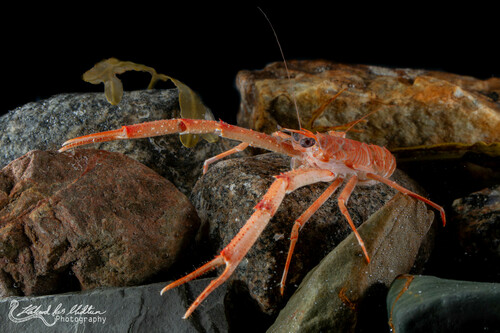
Munida sarsi
Crustaceans Active day and night

Munida sarsi

Munida sarsi

A vibrant orange scavenger of the North Atlantic depths, Sars' squat lobster is a master of the deep-sea floor. With its elegant, elongated claws and large, specialized eyes, it thrives in the darkness of the continental slope.

0 Sightings
0 Habitats

Quick Identification

straighten

Size

Carapace length 20–30 mm (0.8–1.2 in); total length up to 80 mm (3.1 in)

palette

Colors

Bright orange to reddish-pink carapace and limbs; abdomen often a slightly paler shade; dark, large eyes

visibility

Key Features

  • Elongated, slender claws (chelipeds) nearly twice the body length
  • Large, pigmented eyes optimized for low-light environments
  • Transverse hairy ridges across the carapace
  • Tails usually tucked underneath the body
add_a_photo
Is this a Munida sarsi?

Drop a photo or video to find out instantly

When You’ll See Them

schedule
Activity pattern Active day and night
brightness_5
Peak hours Continuous activity due to dark deep-sea environment
calendar_month
Season Year-round
restaurant
Diet A generalist scavenger and detritivore that feeds on 'marine snow,' small invertebrates, and organic debris settled on the seafloor.
park
Habitat Deep-sea floor, typically on muddy, sandy, or rocky substrates at depths of 100 to 800+ metres.

public Geographic range

Where Does the Munida sarsi Live?

Sars' squat lobster is a characteristic species of the North Atlantic Ocean. It is found predominantly along the European continental shelf, with high population densities recorded off the coasts of Norway, the Faroe Islands, and the northern British Isles. Its range extends southward toward the Bay of Biscay and occasionally reaches the Mediterranean, though it remains most common in the colder, nutrient-dense waters of the northern latitudes.

Basemap © OpenStreetMap contributors

7 Countries
2.8M km² Range
Least Concern Conservation
NO Norway
Marginal
GB United Kingdom
Marginal
Ireland
Marginal
Iceland
Marginal
Faroe Islands
Marginal
eco
iNaturalist / Verified observation data
View on iNaturalist open_in_new

Explore more Crustaceans arrow_forward

Behavior

Munida sarsi, commonly known as Sars' squat lobster, is a highly active benthic crustacean. Unlike true lobsters, they are more closely related to porcelain crabs and hermit crabs. They are frequently found in large numbers on the seafloor, where they play a vital role as scavengers. They are known for their 'tail-flip' swimming motion, a rapid escape mechanism used to dart backward when threatened by predators like cod or monkfish.

These crustaceans are often associated with deep-water coral reefs, such as those formed by Lophelia pertusa. They use these reef structures as both a hunting ground and a refuge from the currents. While they are not truly social, they exhibit high tolerance for neighbors, often crowding together in areas with high food availability, such as nutrient-rich currents along the continental slope.

photo_camera EverydayEarth exclusive

Camera Tips

Capturing Munida sarsi requires specialized equipment as they live far deeper than standard consumer trail cameras can reach. For those exploring coastal fjords or deep-shelf environments, a submersible 'drop-camera' or an ROV (Remotely Operated Vehicle) with a high-pressure housing is essential. Use high-powered LED floodlights with a high Color Rendering Index (CRI) to accurately capture their brilliant orange-red coloration, which otherwise appears gray in the deep sea.

Placement should focus on transition zones, such as the edge of a rocky reef or near deep-sea sponge gardens. These areas act as natural highways for squat lobsters. To attract them into the frame, use a perforated bait canister filled with oily fish like mackerel or sardines. The scent trail will often draw dozens of individuals to the camera site within an hour, providing excellent opportunities for group behavioral shots.

Set your camera to a wide-angle focal length to capture as much of the seafloor as possible, as these creatures move quickly across the silt. If using a motion-triggered system, ensure the sensitivity is high, as their slender legs may not always trip PIR sensors; time-lapse photography set at 30-second intervals is often a more reliable way to document their presence over a long deployment.

Frequently Asked Questions

Munida sarsi live in the 'midnight zone' or deep shelf where sunlight rarely reaches, so they are active day and night without a traditional circadian rhythm.
The best way to attract them is by using a bait bag filled with chopped fish. They have a keen sense of smell and will crawl from significant distances to investigate a food source.
They are primarily scavengers that eat organic detritus (marine snow) and small crustaceans, but they will also opportunistically hunt small worms and larvae.
No, Munida sarsi is a marine species found only in deep ocean waters, typically starting at depths of 100 metres and deeper.
Munida sarsi generally has a more slender build and lives in deeper water than Munida rugosa; additionally, M. sarsi lacks the small spines on the fourth abdominal segment often found in related species.

Record Munida sarsi at your habitat

Connect a camera to start building your own species record — AI identifies every visitor automatically.

Join free Identify a photo