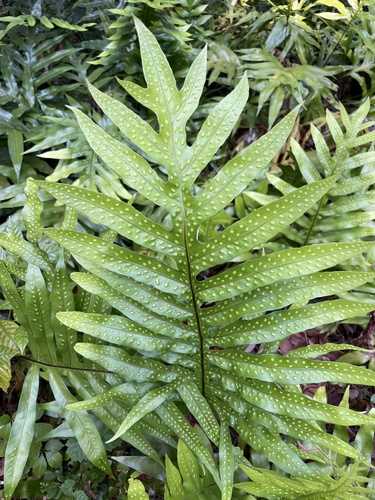
Musk Fern
Microsorum grossum
A fragrant icon of the Pacific, the Musk Fern is a resilient climber and groundcover known for its deeply lobed leaves and sweet, heavy scent. It serves as a vital tropical 'apartment complex' for frogs and small reptiles.
Quick Identification
Size
Fronds typically range from 60–100 cm (24–40 in) in length and 20–40 cm (8–15 in) in width.
Colors
Bright emerald to deep forest green; sori (spores) are orange-brown to yellow; rhizomes are dark brown with scales.
Key Features
- Deeply lobed (pinnatifid) fronds that resemble a large hand
- Large, circular sori arranged in rows on the leaf underside
- Creeping, scaly rhizomes that allow it to climb or spread
- Distinctive musk-like fragrance when the foliage is crushed
When You’ll See Them
Behavior
The Musk Fern is a hardy and versatile plant species that exhibits a 'creeping' growth habit. Using its thick, fleshy rhizomes, it spreads across the forest floor or scales the trunks of trees as an epiphyte. Unlike many delicate ferns, the Musk Fern is quite robust and can withstand periods of dry weather and salt spray, making it a dominant presence in coastal tropical ecosystems.
While it doesn't move in the traditional sense, its growth is a response to light and moisture availability. It interacts with the environment by providing a micro-habitat for small garden visitors. The dense, leathery fronds offer excellent camouflage and shelter for tree frogs, small lizards, and various insects. In many Pacific cultures, the fern is intentionally harvested and bruised to release its namesake scent for use in traditional weaving and ceremonies.
EverydayEarth exclusive
Camera Tips
Capturing the Musk Fern on a trail camera is a fascinating exercise in botanical time-lapse photography. Because ferns don't move like animals, the best way to see them 'in action' is by setting your camera to time-lapse mode with an interval of one photo every 4–6 hours. This will allow you to see the dramatic 'unfurling' of new fiddleheads (croziers) as they expand into massive green fronds over several days. This is most spectacular during the onset of the wet season when growth is rapid.
To capture the animals that frequent the Musk Fern, place your camera on a short tripod or mount it low to the ground, roughly 12–18 inches high. Angle the lens to look across the top of the fronds rather than directly down into them. This profile view is excellent for spotting tree frogs or geckos that perch on the leaves at night. Since the fronds have a slightly waxy, reflective surface, you should avoid using a direct front-facing flash; instead, position the camera at a slight angle to the plant to prevent 'white-out' from the infrared LED bounce-back.
If you are using video mode, look for a day with a light breeze. The Musk Fern has a very particular rhythmic sway due to the weight of its lobes. High-definition video at 60fps can capture the graceful movement of the fronds, which adds a professional 'nature documentary' feel to your backyard footage. If you have a macro setting or a close-focus lens, try to aim it at the underside of a mature frond to capture the development of the sori (spore clusters), which change from flat yellow discs to raised orange bumps over time.
Lastly, consider the 'wet look.' Musk Ferns look their best immediately after rain. If you are setting up your camera in a garden, capturing footage during or just after a sunshower will make the green colors pop and the textures of the rhizomes more visible. The moisture also often brings out the snails and slugs that feed around the base of the fern, providing a more diverse range of 'wildlife' for your camera to trigger on.
Frequently Asked Questions
Record Musk Fern at your habitat
Connect a camera to start building your own species record — AI identifies every visitor automatically.