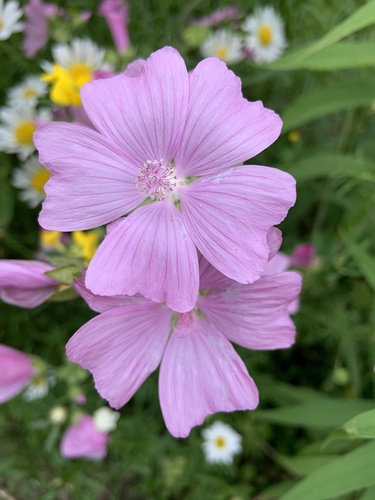
musk mallow
Malva moschata
A summer staple with lace-like leaves and romantic pink blooms, the musk mallow is a pollinator's paradise. This elegant wildflower brings a touch of wild Eurasian meadow charm to any backyard or trail camera view.
Quick Identification
Size
Stands 30 to 80 cm (12 to 32 inches) tall with flowers measuring 3 to 6 cm (1.2 to 2.4 inches) across
Colors
Soft rose-pink to snowy white petals with faint lavender veins and bright green, deeply-cut foliage
Key Features
- Deeply divided, feathery upper leaves
- Five heart-shaped petals with notched tips
- Column of fused stamens in the flower center
- Faint musky scent particularly in warm weather
When You’ll See Them
Behavior
Musk mallow is a perennial wildflower known for its delicate, airy appearance and its role as a cornerstone of the summer meadow. Unlike the more robust and sometimes weedy appearance of its cousins, this species maintains a refined silhouette thanks to its finely laciniate (deeply cut) upper leaves. It is a highly social plant within the ecosystem, serving as a primary nectar source for a wide variety of long-tongued bees, hoverflies, and butterflies during the hottest months of the year.
As a heliotropic plant, its blooms are most vibrant and open during the peak daylight hours, following the sun's path to maximize exposure for pollinators. While it is a stationary species, it displays a rhythmic life cycle; flowers typically open in the mid-morning and may close slightly during heavy rain or at dusk. It is a prolific self-seeder, often forming charming, localized colonies that return to the same garden corner year after year without becoming overly aggressive.
EverydayEarth exclusive
Camera Tips
To capture the true beauty of musk mallow on your trail or backyard camera, placement is everything. Since this plant reaches a modest height, position your camera on a short tripod or a ground stake at a height of about 18 to 24 inches. Angle the lens slightly downward to peer into the heart of the upward-facing blossoms. This perspective is perfect for the EverydayEarth AI to identify not just the plant, but the frequent insect visitors that land on the central stamen column.
Lighting is your best friend when photographing the delicate, translucent petals of the musk mallow. Avoid placing the camera where it faces directly into the morning or afternoon sun, which can cause lens flare and wash out the soft pink tones. Instead, aim for a position where the plant is backlit or side-lit during the 'golden hour.' The thin petals will glow beautifully when light passes through them from behind, highlighting the intricate veining that guides bees toward the nectar.
Because musk mallow has thin, flexible stems, wind can be a challenge for motion-activated cameras. To prevent 'false triggers' where the camera records nothing but swaying stems, try to shelter the plant with a small decorative stone or garden feature, or adjust your camera's sensitivity settings. If your camera supports time-lapse mode, set it to take a frame every 5 minutes from sunrise to sunset. This will create a spectacular sequence of the blooms unfurling as the day warms up and the subsequent arrival of the 'pollinator parade.'
For the highest quality images, ensure there is a contrasting background. A dark green hedge or a shaded fence line behind the pink flowers will make the colors pop and help the AI recognition software differentiate the plant from the surrounding grass. If you are specifically looking to capture butterflies or bees, early morning is the best time to start your recording, as insects are often slower and more likely to pose for the camera while they warm up in the sun.
Frequently Asked Questions
Record musk mallow at your habitat
Connect a camera to start building your own species record — AI identifies every visitor automatically.