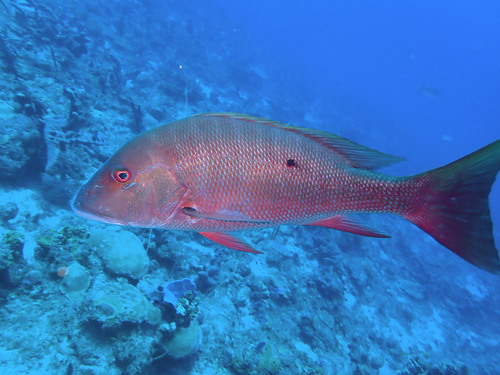
Mutton Snapper
Lutjanus analis
The Mutton Snapper is a master of the reef, recognized by its striking blue 'eyeliner' and a signature black spot. A prize find for coastal backyard cameras, this intelligent fish brings a splash of Caribbean color to any underwater view.
Quick Identification
Size
Typically 50–75 cm (20–30 in) in length and 5–15 kg (10–30 lbs); maximum recorded length of 94 cm (37 in).
Colors
Olive-green back and upper sides with a reddish or pinkish underside; distinguished by a small black spot on the upper side and bright blue lines below the eyes.
Key Features
- Distinctive small black spot above the lateral line near the dorsal fin
- Pointed anal fin, unlike the rounded fins of similar snappers
- Bright blue 'eyeliner' streaks under the eyes
- Vibrant reddish-pink pelvic and anal fins
When You’ll See Them
Geographic range
Where Does the Mutton Snapper Live?
The Mutton Snapper is a native resident of the Western Atlantic Ocean, with a range that begins as far north as Massachusetts and extends southward through the Gulf of Mexico and the Caribbean Sea to the coast of Brazil. They are most densely populated in the tropical waters surrounding South Florida, the Bahamas, and the Antilles, where the warm climate and coral ecosystems provide ideal breeding grounds. While they are occasionally found in temperate northern waters during the summer, they are considered a core tropical species of the Caribbean basin.
Basemap © OpenStreetMap contributors
Behavior
Mutton Snapper are known for being more solitary and wary than other snapper species, often patrolling coral reefs, seagrass beds, and sandy flats alone or in small, loose groups. While many snappers are strictly nocturnal, the Mutton Snapper is quite active during the day, making them a common sight for underwater observers. They are intelligent and cautious, often keeping a safe distance from humans unless they become accustomed to a specific feeding area.
Socially, they are relatively independent until the spawning season, typically around the full moons of spring and summer, when they gather in massive aggregations. These fish exhibit high site fidelity, often returning to the same reef or patch of seagrass day after day. In dockside environments, they are opportunistic, using the shadows of man-made structures to ambush prey while remaining hidden from larger predators like barracudas or sharks.
EverydayEarth exclusive
Camera Tips
For homeowners with canal-front property or private docks, capturing a Mutton Snapper requires a submersible camera or an underwater housing with high-quality low-light capabilities. Position your camera approximately 1 to 2 feet above the seafloor, angled slightly upward toward a structural feature like a dock piling or a rock ledge. Mutton Snappers are wary of movement, so a fixed, stationary mount is far more effective than a handheld or dangling camera that might sway in the current.
Natural light is your best friend, so try to capture footage during the midday hours when the sun is directly overhead to penetrate the water column. However, if your camera has infrared or high-sensitivity sensors, the 'golden hours' of dawn and dusk often see the most predatory action. To lure a Mutton Snapper into the frame, consider using a scent-based attractant or a mesh bait bag filled with crushed crabs or frozen shrimp. Unlike bolder fish, the Mutton may circle the bait for several minutes before approaching, so ensure your camera is set to a long recording duration or use a high-sensitivity motion trigger.
Water clarity is the biggest challenge for AI-powered backyard cameras. Aim for days with calm winds and incoming tides, which bring in clearer ocean water compared to the murky runoff often seen on outgoing tides. If your camera settings allow, increase the saturation slightly to help the AI distinguish the Mutton Snapper’s subtle pink hues and blue facial markings from the sandy or green background of the seafloor.
Similar Species
Species that look similar or are commonly confused with Mutton Snapper.
Frequently Asked Questions
Record Mutton Snapper at your habitat
Connect a camera to start building your own species record — AI identifies every visitor automatically.