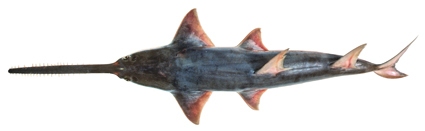
Narrow Sawfish
Anoxypristis cuspidata
Meet the ocean's most unique craftsman, a shark-like ray equipped with a tooth-lined 'saw' used for hunting in the tropical shallows.
Quick Identification
Size
Typically reaches 2.4 to 3.5 metres (7.9 to 11.5 feet) in length; weight can reach up to 150 kg (330 lbs).
Colors
Pale grey to greenish-brown on the upper body with a starkly white or cream underside; fins are usually a translucent pale grey.
Key Features
- Elongated rostrum with 16–29 pairs of teeth
- Basal quarter of the saw is entirely smooth and toothless
- Distinctly shark-like body with a flat ventral surface
- Symmetrical tail fin with a well-developed lower lobe
When You’ll See Them
Geographic range
Where Does the Narrow Sawfish Live?
The Narrow Sawfish is native to the expansive Indo-West Pacific region, where it patrols the warm, shallow shelf waters. Its core range extends from the Persian Gulf across the northern Indian Ocean to Southeast Asia, including Indonesia and Papua New Guinea, and as far north as southern Japan. Northern Australia remains one of its most critical strongholds, where the species is still frequently sighted in the tropical waters of the Gulf of Carpentaria and the Kimberley region.
Basemap © OpenStreetMap contributors
Behavior
The Narrow Sawfish is a fascinating cartilaginous fish that bridges the gap between the lifestyle of a shark and a ray. Unlike many other sawfish species that spend the majority of their time resting on the sea floor, the Narrow Sawfish is a more active swimmer, often found cruising through the mid-water column of shallow coastal areas. They are generally solitary creatures but may gather in areas where prey is abundant, particularly near river mouths during the wet season.
Their most iconic behavior involves the use of their rostrum, or 'saw.' This organ is packed with electroreceptors called ampullae of Lorenzini, which allow the sawfish to detect the tiny heartbeats of prey buried in the silt. When hunting, they use the saw like a weapon, swiping it through schools of fish to stun or impale them, or using it to dig up crustaceans from the muddy substrate. While they are large and look formidable, they are generally shy around humans and will swim away if disturbed, though they can defend themselves with a powerful sideways swipe of the saw if cornered.
EverydayEarth exclusive
Camera Tips
Capturing a Narrow Sawfish on camera requires specialized underwater equipment, as these are marine animals. For those living near tropical estuaries or docks in Northern Australia or Southeast Asia, a waterproof 'drop cam' or a trail camera housed in a professional dive casing is essential. Position your camera near structural features like pier pilings or at the edge of mangrove roots where sawfish are known to forage for small fish. Since these areas are often murky, placing the camera within 1-2 feet of a 'bait station' is the most effective way to ensure a clear image.
Use a perforated PVC pipe filled with oily fish like sardines or mullet as a lure. The scent will draw the sawfish in, and their electroreceptive saw will likely investigate the metal or plastic casing of the camera itself. Because PIR (Passive Infrared) sensors do not work underwater, you must set your camera to 'Time Lapse' mode. A frequency of one photo every 30 seconds, or a 10-second video every minute, is recommended to capture a passing individual without draining the battery too quickly.
Visibility is your biggest challenge. Aim to deploy your camera during 'neap tides' when water movement is minimal and sediment settles. If you are mounting the camera on a dock looking down into shallow water, use a circular polarizing filter on the lens to cut through surface glare. The best results often come from night deployments using infrared (IR) flash, as sawfish are highly active under the cover of darkness and are less likely to be spooked by visible light.
Similar Species
Species that look similar or are commonly confused with Narrow Sawfish.
Frequently Asked Questions
Record Narrow Sawfish at your habitat
Connect a camera to start building your own species record — AI identifies every visitor automatically.