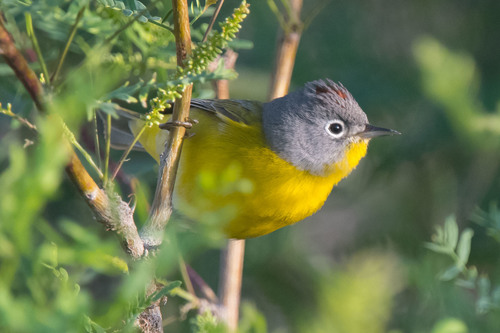
Nashville Warbler
Leiothlypis ruficapilla
A splash of morning sunlight in the undergrowth, the Nashville Warbler is a tiny dynamo defined by its sharp gray hood and constant motion. Look for its signature white eye-ring and rhythmic tail-twitches during the peak of migration.
Quick Identification
Size
Length: 4.3–5.1 in (11–13 cm); Wingspan: 6.7–7.9 in (17–20 cm); Weight: 0.2–0.4 oz (7–12 g)
Colors
Distinctive gray head and olive-green back; bright yellow throat, breast, and belly; conspicuous white eye-ring; males have a small rufous crown patch that is usually hidden.
Key Features
- Prominent white eye-ring on a gray head
- Bright yellow throat and underparts
- Olive-green wings and back with no wing bars
- Constant downward tail-twitching behavior
When You’ll See Them
Behavior
Nashville Warblers are high-energy foragers known for their 'nervous' disposition. They are almost constantly in motion, hopping through low-to-mid-level vegetation while frequently twitching their tails downward. Unlike many of their canopy-dwelling cousins, these warblers prefer the shrubby interfaces of forest edges and clearings, making them more accessible to backyard observers.
During the breeding season, they are famous for their two-part song: a series of high-pitched notes followed by a lower, faster trill. While they are primarily solitary or found in pairs during the summer, they frequently join mixed-species foraging flocks during migration, often traveling alongside chickadees and other warbler species. They are ground-nesters, concealing their homes expertly in moss or leaf litter.
EverydayEarth exclusive
Camera Tips
To capture the Nashville Warbler on an AI-powered camera, you must think low. Because these birds nest on the ground and forage in the understory, place your camera at a height of 12 to 36 inches off the ground. Aiming the lens at a cluster of native shrubs or a patch of leaf litter near a forest edge is your best bet. If your camera allows for sensitivity adjustments, set it to high—these birds are small and move with a rapid, jerky cadence that can easily be missed by slower sensors.
The absolute best way to lure a Nashville Warbler into camera range is through a water feature. They are particularly drawn to the sound of splashing or dripping water. Position your camera 3 to 5 feet away from a bird bath that includes a solar-powered dripper or a small fountain. Ensure the water source is located near cover, as these warblers are shy and like to have a quick 'escape route' into dense foliage after bathing. Early morning light provides the best color accuracy for their yellow feathers, so try to face your camera north or south to avoid direct lens flare during the peak morning hours.
Since these birds do not eat traditional birdseed, avoid placing the camera at a standard seed feeder. Instead, if you want to use a lure, try a platform feeder with live mealworms or a suet cage with high-protein 'insect' blends. During migration, look for 'hotspots' in your yard where insects are abundant, such as near flowering native plants. Setting your camera to 'Burst Mode' or 'High-Speed Video' is highly recommended to catch their characteristic tail-flicking, which is a key identifying behavior that the AI can use to confirm the species.
Similar Species
Species that look similar or are commonly confused with Nashville Warbler.
Orange-crowned Warbler
Lacks the crisp white eye-ring and has a much duller, olive-yellow throat and underside.
Connecticut Warbler
Significantly larger and walks on the ground; its gray hood covers the entire throat, unlike the Nashville's yellow throat.
MacGillivray's Warbler
Has broken white 'eye-arcs' rather than a complete eye-ring, and the male has a darker, 'hooded' look with a blackish chest patch.
Frequently Asked Questions
Record Nashville Warbler at your habitat
Connect a camera to start building your own species record — AI identifies every visitor automatically.