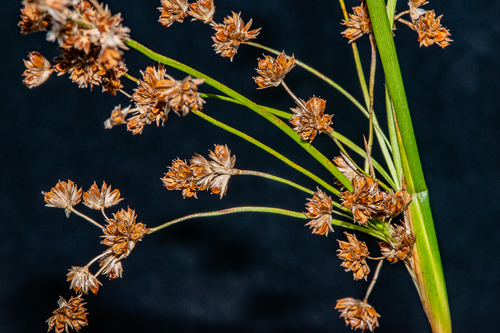
needlegrass rush
Juncus roemerianus
The resilient architect of the 'black marsh,' needlegrass rush forms dense, protective thickets that guard our coastlines. Its needle-sharp tips and dark silhouette provide a mysterious and vital sanctuary for the coast's most elusive wildlife.
Quick Identification
Size
Height ranges from 0.9 to 1.5 meters (3 to 5 feet), with a root spread that can cover several acres through clonal colonies.
Colors
Dull olive-green to gray-green stems that transition to a distinct dark brown or blackish color at the sharp, pointed tips.
Key Features
- Rigid, cylindrical stems that taper to a very sharp, needle-like point
- Forms dense, dark-colored 'black marshes' along coastlines
- Small, branched clusters of greenish-brown flowers appearing near the stem tips
- Massive underground rhizome systems that stabilize coastal soil
When You’ll See Them
Behavior
Needlegrass rush is a dominant perennial plant that characterizes the 'high marsh' zones of North American salt marshes. It is famous for creating dense monocultures known as 'black marshes,' so named because the dark-colored tips of the rush give the landscape a charred or blackened appearance from a distance. Unlike many other marsh plants, it is exceptionally hardy and can withstand high salinity levels and occasional droughts that would kill off more sensitive vegetation.
Ecologically, this species acts as a foundational engineer for coastal environments. Its extensive system of underground rhizomes creates a thick, resilient mat that traps sediment and protects the shoreline from the erosive power of waves and storm surges. By forming these impenetrable thickets, it provides a safe haven for secretive marsh birds and a nursery for juvenile fish and crustaceans during high tide cycles, making it a cornerstone of coastal biodiversity.
EverydayEarth exclusive
Camera Tips
Capturing the beauty of needlegrass rush requires a focus on the unique ecosystem it supports. Because the plant is stationary, use its dense, vertical stems as a dramatic 'stage' for the wildlife it attracts. We recommend mounting your AI-powered camera on a sturdy stake or an existing pier at a low angle—about 12 to 18 inches above the mud line. This perspective allows you to peer 'into' the grass forest, which is essential for spotting secretive species like Clapper Rails, Seaside Sparrows, or Marsh Rabbits that use the rush for cover.
Lighting is the biggest challenge when photographing this species. The dark, near-black tips can easily lose detail in flat midday sun or deep shade. To get the best results, orient your camera to capture the 'golden hour' light just after sunrise or before sunset. The low-angled sun will catch the cylindrical texture of the stems and highlight the color contrast between the green bases and dark tips, preventing the marsh from looking like a solid black mass in your photos.
Since needlegrass rush grows in tidal areas, your camera setup must be weather-proof and secured against rising waters. Consider using a time-lapse setting to document the 'breathing' of the marsh; taking a photo every 10 to 15 minutes can reveal how the plant's appearance changes as the tide rolls in and out, often bringing in different visitors like Blue Crabs or Egrets. Look for natural 'edges' where the rush meets open water or a salt panne, as these are high-traffic corridors for wildlife.
Finally, respect the name 'needlerush.' The tips of these plants are remarkably sharp and can easily scratch a camera lens or snag a cable. Ensure your equipment is positioned just outside the reach of the tallest stems to avoid wind-blown stalks triggering false motion alerts or damaging your gear. If you are placing a camera in a dense stand, gently part the stems rather than cutting them to preserve the plant's natural protective barrier for the animals that live within it.
Similar Species
Species that look similar or are commonly confused with needlegrass rush.
Frequently Asked Questions
Record needlegrass rush at your habitat
Connect a camera to start building your own species record — AI identifies every visitor automatically.