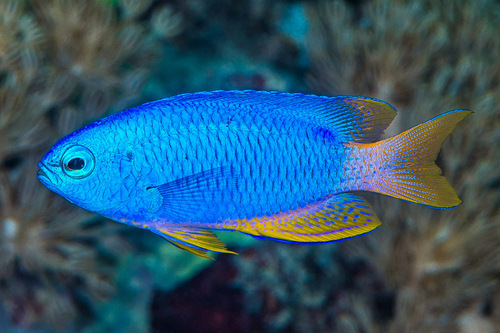
Neon Damselfish
Pomacentrus coelestis
Experience the vibrant flash of the ocean's most electric blue resident. The Neon Damselfish brings a spark of tropical brilliance to every reef and lagoon it calls home.
Quick Identification
Size
Up to 9 cm (3.5 inches) in length
Colors
Brilliant electric neon blue; some regional variations show a yellow or pale underbelly and tail.
Key Features
- Electric neon blue body
- Deeply forked tail fin
- Small dark spot at the base of the pectoral fin
- Streamlined, oval-shaped profile
When You’ll See Them
Geographic range
Where Does the Neon Damselfish Live?
The Neon Damselfish is a jewel of the Indo-Pacific region, spanning a massive area from the eastern coasts of Africa and the Red Sea all the way to the Line Islands. They are a common sight across the Great Barrier Reef in Australia and extend as far north as southern Japan and the Ryukyu Islands. While they are most concentrated in the tropical waters of Southeast Asia and the Pacific Islands, their presence is established across numerous archipelagos within this vast oceanic corridor.
Basemap © OpenStreetMap contributors
Behavior
Neon Damselfish are highly energetic and territorial little fish, often seen darting in and out of coral rubble or rocky crevices. They are diurnal, meaning they are active during the day, spending most of their time foraging for food in the water column or defending their chosen "home" patch from intruders. While they are small, they are surprisingly bold and will aggressively chase away larger fish that wander too close to their nesting sites.
In the wild, they often form loose aggregations rather than tight schools, hovering just above the substrate. This allows them to quickly dive into cover if a predator, like a grouper or snapper, appears. They have a complex social structure where dominant individuals secure the best hiding spots. In terms of human interaction, they are popular in the aquarium trade but remain common and relatively unfazed by divers and snorkelers in their natural reef habitats.
EverydayEarth exclusive
Camera Tips
Capturing the Neon Damselfish on an underwater AI camera requires placement in high-activity "transition zones." These fish love areas where the reef meets the sand or rubble flats. Position your camera about 12-18 inches (30-45 cm) above the substrate, angled slightly downward to catch the shimmer of their scales. Because they are small and fast, a high frame rate or a fast shutter speed setting is essential to prevent "blue blurs" across your footage.
While traditional bait like fish flakes can attract them, it often brings in larger, more aggressive species that might scare the Neon Damselfish away. Instead, look for a "cleaning station" or a specific crevice where a resident is already established. These fish are site-faithful, meaning if you see one in a spot, it will likely return to that exact location throughout the day. Using a camera with a macro lens or a close-focus setting will yield the best results given their small 3.5-inch size.
Lighting is your biggest challenge under the waves. The electric blue color of the Neon Damselfish is best captured during peak sunlight hours (10 AM to 2 PM) when the sun is directly overhead, allowing the light to penetrate the water and reflect off their iridescent scales. If you are using an underwater housing for your AI camera, ensure the lens is clean and consider using a red filter if you are deeper than 5 meters to restore the vibrancy of their neon color.
Frequently Asked Questions
Record Neon Damselfish at your habitat
Connect a camera to start building your own species record — AI identifies every visitor automatically.