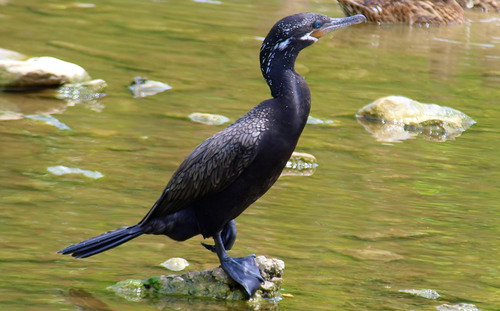
Neotropic Cormorant
Nannopterum brasilianum
The Neotropic Cormorant is a sleek, long-tailed diver that brings a touch of the tropics to backyards across the Americas. Watch for their iconic wing-drying pose on docks and branches near the water's edge.
Quick Identification
Size
Length: 60-70 cm (24-28 in); Wingspan: 100 cm (39 in); Weight: 1.1-1.5 kg (2.4-3.3 lbs)
Colors
Adults are primarily brownish-black with a dull olive-green sheen. Breeding adults develop a white 'V' border at the base of the throat pouch and small white tufts on the head. Juveniles are a lighter, dusty brown.
Key Features
- Slender body with a notably long tail for a cormorant
- Small, triangular yellow-orange throat pouch
- Sharp 'V' shape where facial skin meets feathers
- Hooked bill tip for grasping slippery prey
When You’ll See Them
Behavior
The Neotropic Cormorant is a highly social and masterfully adapted waterbird. Unlike many other aquatic species, its feathers are not entirely waterproof; while this might seem like a disadvantage, it actually allows the bird to sink more easily and maneuver with incredible speed underwater. This physical trait leads to their most iconic behavior: perched on a branch or pier with wings spread wide to dry in the sun and wind.
These birds are gregarious hunters, often seen in small groups or occasionally in large flocks where they may engage in 'communal fishing,' driving schools of fish into shallower water. In suburban settings, they are remarkably tolerant of human presence, frequently utilizing backyard boat docks and fence posts as vantage points. They are quieter than many other waterbirds, though they may emit low, pig-like grunts when at their nesting colonies.
EverydayEarth exclusive
Camera Tips
To capture the best footage of a Neotropic Cormorant, focus your camera placement on 'drying stations' rather than the water itself. These birds have favorite perches—usually a semi-submerged log, a low-hanging branch over water, or a private dock—where they spend hours drying their wings. Set your camera at a slight side-angle to these perches to capture the full wing extension, which provides a dramatic and educational silhouette. Aim for a height of 3 to 5 feet above the water level to get a natural, eye-level perspective.
Because cormorants have dark, iridescent plumage, they can be difficult for AI cameras to expose correctly, often appearing as a black silhouette. If your camera allows for exposure adjustments, try a slight negative compensation to preserve the detail in their feathers, especially in the bright midday sun. If you are placing a camera near a backyard pond, avoid using bait; instead, ensure there is a sturdy, horizontal branch or post at the water’s edge, as this is the best 'natural lure' for this species.
Action shots of Neotropic Cormorants diving or surfacing are exhilarating but require fast trigger speeds. Set your camera to 'Burst Mode' or high-frequency photo capture to catch the moment they emerge from the water with a fish. Since they are most active during the morning and late afternoon, ensure your camera's PIR sensor is sensitive enough to trigger in the softer light of dawn and dusk. In the winter months, look for them near spillways or areas where water remains open and moving, as fish tend to congregate there.
Finally, consider the background. Because these birds are dark, a background with lighter reeds, water reflections, or green foliage will help the bird 'pop' in the frame. Avoid pointing the camera directly toward the sun (south-facing in the northern hemisphere) to prevent lens flare and washed-out images during their peak activity hours.
Similar Species
Species that look similar or are commonly confused with Neotropic Cormorant.
Frequently Asked Questions
Record Neotropic Cormorant at your habitat
Connect a camera to start building your own species record — AI identifies every visitor automatically.