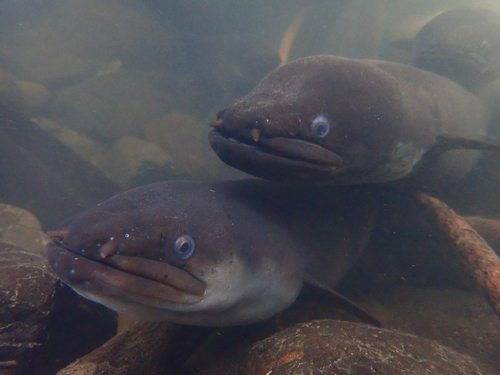
New Zealand Longfin Eel
Anguilla dieffenbachii
A majestic giant of New Zealand's waterways, the Longfin Eel is a mysterious predator that can live for over a century. Discover the ancient 'taniwha' of the streams and learn how to witness their secret underwater lives.
Quick Identification
Size
Typically 80-150 cm (31-59 in), but can reach up to 2 meters (6.5 ft); weights often exceed 10-20 kg (22-44 lbs).
Colors
Dark brown, olive-green, or charcoal on the back; creamy yellow, grayish, or white on the belly. No distinct spotting.
Key Features
- Dorsal fin extends significantly further forward than the anal fin
- Distinctly wrinkled skin folds when the body bends
- Broad, bulbous head with a large mouth reaching past the eyes
- Small, rounded pectoral fins located just behind the gill openings
When You’ll See Them
Behavior
The New Zealand Longfin Eel is a legendary wanderer of Aotearoa’s freshwater systems. These eels are remarkably long-lived, with some females reaching over 80 or even 100 years of age. They spend the vast majority of their lives in rivers and lakes before undergoing a dramatic physical transformation for their final act: a one-way, 4,000-kilometer migration to the deep ocean trenches near Tonga to spawn and die.
Despite their somewhat intimidating size, Longfin Eels are often curious and can become quite accustomed to human presence, especially if they are regularly fed in a specific spot. They are masters of their environment, capable of climbing steep waterfalls and damp rocks as juveniles (elvers) to reach high-country streams. As adults, they are solitary and territorial, often occupying the same deep hole or undercut bank for decades.
EverydayEarth exclusive
Camera Tips
To capture the New Zealand Longfin Eel on camera, you will need a dedicated underwater setup or a high-quality waterproof action camera. Because these eels are almost exclusively nocturnal, ensure your camera has excellent low-light capabilities or infrared (IR) night vision. Position your camera in slow-moving water, specifically near 'snags' like submerged logs, large boulders, or undercut banks where eels hide during the day. Setting the camera at a depth of 0.5 to 1 meter, angled slightly downward toward the riverbed, provides the best perspective for capturing their length and movement.
Baiting is the most effective way to draw a Longfin Eel into your camera's field of view. Use a mesh bag or a perforated plastic container filled with oily fish (such as sardines or salmon) or raw meat. Secure the bait firmly to a rock or stake directly in front of the lens. The scent trail will travel downstream, attracting any nearby eels. Once an eel finds the bait, it will often linger, giving you ample time to capture detailed footage. Check local regulations to ensure baiting is permitted in your specific waterway before proceeding.
For the best visual results, prioritize video over still photos. The undulating, serpentine swimming motion of the Longfin Eel is its most striking feature and is best appreciated in motion. Set your camera to record 30-second clips with a short trigger interval. During the summer months, water clarity is usually better, and eels are more active due to warmer temperatures. However, avoid filming immediately after heavy rain, as suspended sediment and 'river 'snow' can cloud the water and trigger false motion alerts on your camera.
Frequently Asked Questions
Record New Zealand Longfin Eel at your habitat
Connect a camera to start building your own species record — AI identifies every visitor automatically.