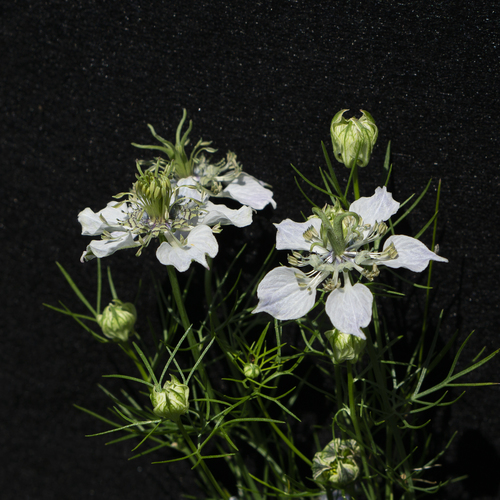
Nigella
Nigella sativa
Famed for its 'Love-in-a-Mist' foliage and spicy black seeds, Nigella sativa is a Mediterranean treasure that brings both beauty and biodiversity to the backyard garden.
Quick Identification
Size
Grows to a height of 20–30 cm (8–12 inches) with a spread of approximately 15 cm (6 inches).
Colors
Flowers are usually pale blue or white; seeds are a deep, matte black; foliage is a bright, feathery green.
Key Features
- Finely divided, feathery green leaves that create a misty appearance
- Delicate flowers with 5 to 10 petals in shades of white or pale blue
- Large, inflated green seed capsules that turn brown and papery when mature
- Small, pungent black seeds with a distinctive triangular shape
When You’ll See Them
Geographic range
Where Does the Nigella Live?
Nigella sativa is native to the sun-soaked regions of Western Asia and Eastern Europe, with its historical core spanning from Turkey and Syria to the Iranian plateau. Over centuries of use as a spice and medicine, it has naturalized across the Mediterranean basin, Northern Africa, and as far east as the Indian subcontinent and Myanmar. In modern times, it is found globally in temperate zones where it is frequently cultivated in backyard gardens and occasionally escapes into the wild as a hardy, self-seeding annual.
Basemap © OpenStreetMap contributors
Behavior
Nigella sativa, often referred to as Black Cumin or Kalonji, is an annual herb that follows a rapid and rhythmic growth cycle. Emerging in the spring, it quickly develops its signature feathery foliage, which serves as a protective 'mist' around the developing buds. Unlike animals, its 'behavior' is observed through its phenology—the timing of its flowering and seed production. The flowers typically open in the morning and are highly sensitive to light, providing a reliable source of nectar for local pollinators during the peak of the day.
The plant has a fascinating relationship with the animal kingdom. Its flowers are specifically structured to encourage visits from bees and hoverflies, which are the primary agents of its pollination. Once fertilization occurs, the plant redirects its energy into forming complex, bulbous seed capsules. As the season ends, the plant withers, and the capsules become dry and brittle, eventually splitting open to scatter its seeds via wind or through the intervention of birds and small mammals that forage among the dried stalks.
EverydayEarth exclusive
Camera Tips
To successfully capture Nigella sativa on your backyard camera, you should focus on the two most dynamic aspects of its life: its growth cycle and its visitors. For the plant itself, time-lapse is the essential setting. Place your camera on a sturdy stake or tripod approximately 2 feet away from the plant, at a height of about 12 inches. Set the interval to one photo every hour. This will allow you to compress months of growth into a few minutes, highlighting the dramatic unfolding of the feathery leaves and the 'explosion' of the flowers.
If you want to film the wildlife that Nigella attracts, focus your lens on the flowers during their peak blooming period in mid-summer. Nigella is a magnet for pollinators, especially honeybees and clearwing moths. Use a high-speed video setting (60fps or higher) and ensure your camera has a close-focus or macro capability. Position the camera so the morning sun (8 AM - 11 AM) hits the flowers from the side; this backlights the 'misty' foliage and makes the pale blue petals pop against the background.
In late autumn, the dried seed pods become the main attraction. Lower your camera to ground level to capture ground-feeding birds like finches or small rodents like chipmunks that may visit to investigate the fallen seeds. If your camera has a PIR (Passive Infrared) sensor, adjust the sensitivity to high, as the movement of small birds among the thin stalks can be subtle. Avoid placing the camera too close to the ground in wet weather, as rain splash can blur the lens and obscure the delicate details of the seed capsules.
Frequently Asked Questions
Record Nigella at your habitat
Connect a camera to start building your own species record — AI identifies every visitor automatically.