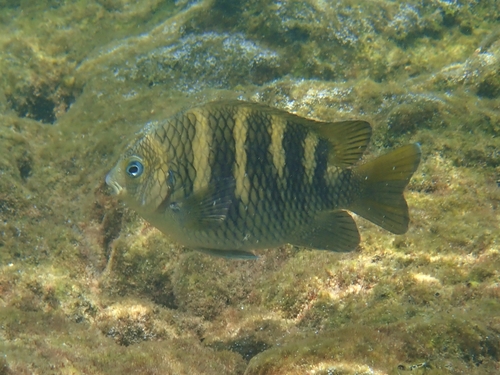
Night Sergeant
Abudefduf taurus
A rugged and territorial guardian of the rocky shallows, the Night Sergeant is a master of life in the surge. With its bold vertical stripes and fearless personality, it is a fascinating species to observe in coastal backyards.
Quick Identification
Size
Total length up to 25 cm (9.8 in); commonly between 15 and 20 cm (6-8 in)
Colors
Dull yellow to brownish-grey base; 5-6 broad, dark brown or black vertical bars on the flanks
Key Features
- Stocky, heavy-bodied damselfish profile
- 5-6 broad dark vertical bands
- Blunt snout with a small mouth
- Slightly forked tail fin with rounded lobes
When You’ll See Them
Geographic range
Where Does the Night Sergeant Live?
The Night Sergeant is a native resident of the warm coastal waters of the Western Atlantic Ocean. Its primary range begins along the shores of southern Florida and the Florida Keys, extending through the Gulf of Mexico and across the entire Caribbean Sea. It is commonly found throughout the West Indies and along the Central and South American coastlines as far south as Uruguay, though it is most densely populated in the tropical waters of the Greater Antilles.
Basemap © OpenStreetMap contributors
Behavior
The Night Sergeant is a remarkably hardy and territorial member of the damselfish family. Unlike its more colorful relatives that frequent deep coral reefs, this species is a specialist of the 'surge zone'—the turbulent, shallow waters where waves break against rocky shores. They are famously bold, with individual fish often claiming a specific crevice or limestone ledge as their own and defending it vigorously against intruders, including larger fish and curious snorkelers.
Despite its name, the Night Sergeant is primarily diurnal, meaning it is most active during daylight hours. They spend their days grazing on algae-covered rocks or darting into the water column to snag passing snacks. During the breeding season, their territorial nature intensifies; males will clear a patch of rock to attract a female and then stay to guard the purple-hued egg mass until they hatch, fanning them with their fins to provide oxygen.
EverydayEarth exclusive
Camera Tips
Capturing the Night Sergeant requires a specialized approach since they live in the highly oxygenated, bubbly waters of the surf zone. If you have a backyard dock or live on a canal, the best setup is a waterproof action camera mounted to a weighted tripod or a PVC pipe arm. Position the lens about 1 to 2 feet underwater, facing a vertical surface like a dock piling or a large rock. These fish love 'structure' and will naturally gravitate toward the camera if it is placed near their home crevice.
Because the water in their preferred habitat is often turbid from wave action, timing is everything. Aim to record during 'slack tide' when the water movement is minimal, or during the middle of the day when the sun is directly overhead. High sun helps penetrate the bubbles and silt, providing the clarity needed for AI detection software to trigger. If your camera settings allow, increase the shutter speed to 1/120 or higher to freeze the motion of these fast-moving fish in the surge.
To draw them into the frame, you don't necessarily need exotic bait. A simple mesh bag filled with crushed sea shells or a piece of algae-covered rock moved into a well-lit area will often pique their curiosity. Since they are highly territorial, once you identify an individual's 'patrol route,' you can reliably place your camera in the same spot day after day to capture their social interactions and feeding habits.
Similar Species
Species that look similar or are commonly confused with Night Sergeant.
Frequently Asked Questions
Record Night Sergeant at your habitat
Connect a camera to start building your own species record — AI identifies every visitor automatically.