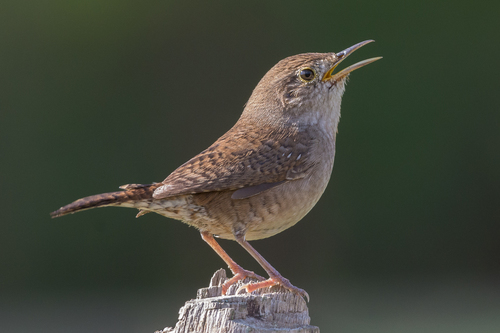
Northern House Wren
Troglodytes aedon
A pint-sized powerhouse with a voice that fills the garden, the Northern House Wren is the ultimate backyard architect. Watch as these feisty birds transform a simple birdhouse into a twig-filled fortress.
Quick Identification
Size
Length: 11-13 cm (4.3-5.1 in); Wingspan: 15 cm (6 in); Weight: 10-12 g (0.35-0.42 oz)
Colors
Uniformly brown upperparts with dark barring on the wings and tail; pale grayish-brown underparts; subtle, faint pale eyebrow
Key Features
- Small, stocky body with a short tail often held upright
- Distinctive dark barring on wings and tail feathers
- Thin, slightly decurved bill for plucking insects
- Energetic, 'bubbly' song consisting of rapid chirps and trills
When You’ll See Them
Sightings on EverydayEarth
Jun 14, 2026
A juvenile Bald Eagle is perched on a branch overlooking a lush green valley. It turns its head to look around and briefly adjusts its wings. Below it on a separate branch, a small House Wren is perched, occasionally moving its head and looking around.
May 24, 2026
A Northern House Wren hops onto the white feeder tray, investigating the scattered seeds. It stays for a few moments before flying out of view, then makes a brief reappearance at the end of the recording.
Apr 20, 2026
A small Northern House Wren lands on the edge of a copper-colored feeding dish. It perches momentarily, looking around and inspecting the dish before hopping along the rim.
Apr 19, 2026
A Northern House Wren lands on the rim of a copper dish on the shepherd's hook. It pauses briefly, looking around the garden, before flying off to the right. The surrounding bird feeders are swaying steadily in the wind.
Apr 16, 2026
A House Wren lands on the edge of the bird feeder, perching momentarily with its barred tail visible before hopping quickly to the left and out of the main frame.
Behavior
The Northern House Wren is a tiny bird with a massive personality. These birds are incredibly energetic and vocal, often heard long before they are seen. They are famous for their 'busy' nature, constantly flitting through low vegetation and hopping along the ground in search of insects. Despite their small size, they are fiercely territorial during the breeding season and will aggressively defend their chosen nesting sites from much larger birds.
One of their most unique behaviors is the construction of 'dummy nests.' A male Northern House Wren will arrive at a breeding ground and proceed to fill every available cavity—from birdhouses to flowerpots—with sticks. This serves to claim the territory and give the female several options to choose from. Once a site is selected, the female adds the soft lining. While they are a joy to have in the garden, be aware that they can be competitive neighbors, sometimes removing the eggs of other birds to secure their preferred nesting spot.
EverydayEarth exclusive
Camera Tips
To capture high-quality footage of a Northern House Wren, the best strategy is to focus on their nesting and territorial behaviors. If you have a nest box in your yard, mount your AI-powered camera 2 to 4 feet away, aimed directly at the entrance. Because these birds move with lightning speed, ensure your camera is set to its highest trigger speed (ideally under 0.2 seconds). Using a 'burst' or 'photo+video' mode is highly recommended, as it allows you to catch the precise moment the bird lands with a beak full of sticks or insects.
If you don't have a nest box, look for a 'brush pile' or a dense thicket of shrubs. Wrens spend much of their time foraging low to the ground. Set your camera on a low tripod or mount it about 12 to 18 inches off the ground near the edge of a brush heap. Creating a 'perch'—a single attractive branch placed just in front of the camera—will encourage the wren to pause for a few seconds before disappearing into the brush, giving your camera time to focus and record a clear image.
Lighting is key for capturing the subtle barring on a wren's wings. Early morning light (the first two hours after sunrise) provides the best contrast without the harsh shadows of midday. Since Northern House Wrens are drawn to water for bathing but rarely visit traditional bird feeders, placing your camera near a shallow, ground-level birdbath is a secret weapon for great shots. The splashing action is a perfect trigger for motion-activated cameras and results in some of the most charming backyard footage possible.
Similar Species
Species that look similar or are commonly confused with Northern House Wren.
Carolina Wren
Larger and chunkier with a distinct, bold white eyebrow stripe and a brighter buff-colored belly.
Bewick's Wren
Features a much more prominent white eyebrow and longer tail feathers with white corners.
Winter Wren
Smaller and darker with a much shorter tail and more heavy barring on the belly.
Frequently Asked Questions
Record Northern House Wren at your habitat
Connect a camera to start building your own species record — AI identifies every visitor automatically.