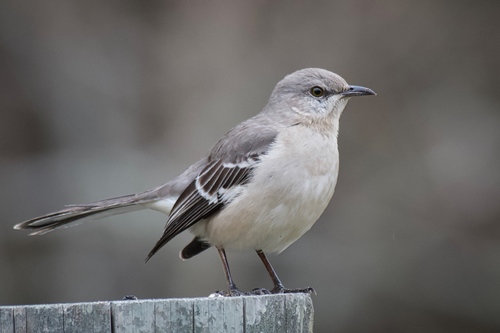
Northern Mockingbird
Mimus polyglottos
Meet the backyard's most talented vocal gymnast. The Northern Mockingbird doesn't just sing; it performs a curated playlist of every sound in its neighborhood, from songbird trills to cricket chirps.
Quick Identification
Size
Length: 8.2–10.2 in (21–26 cm); Wingspan: 12.2–13.8 in (31–35 cm); Weight: 1.4–2.0 oz (40–58 g)
Colors
Uniform grayish-brown upperparts with a pale, off-white breast and belly; wings feature two white bars and large white patches visible in flight.
Key Features
- Large white wing patches visible during flight or wing-flashing
- Long, slender tail with white outer feathers
- Pale yellow or orange iris in adults
- Slender, slightly curved black bill
When You’ll See Them
Behavior
The Northern Mockingbird is a master of mimicry and a bold protector of its territory. These birds are famous for their ability to learn and repeat the songs of dozens of other bird species, as well as man-made sounds like car alarms or sirens. They are highly intelligent and have been known to recognize individual humans who frequently visit their territory. You will often see them perched high on a fence or chimney, singing a complex medley of tunes to announce their presence.
In the backyard, they exhibit a unique behavior known as "wing-flashing," where they extend their wings in jerky movements to show off their white patches. This is believed to startle insects out of hiding. While they are generally solitary or found in pairs, they become incredibly aggressive during nesting season, fearlessly chasing away crows, hawks, and even house cats that venture too close to their nest sites.
EverydayEarth exclusive
Camera Tips
To capture the best footage of a Northern Mockingbird, place your camera near low-hanging fruit bushes or ornamental berry plants like holly, pyracantha, or beautyberry. These birds are highly motivated by fruit in the winter months and will return to the same branch repeatedly. Position the camera at a height of 3 to 5 feet, angled slightly upward if they are perching, or downward if you are targeting a patch of open mulch where they love to hunt for insects.
If you want to lure them specifically into your camera's field of view, try offering mealworms or suet nuggets in a flat tray feeder rather than a hanging one. Mockingbirds prefer stable surfaces over swinging feeders. Because they are ground-foragers, placing a camera near a birdbath is also highly effective; they are frequent bathers and tend to be quite splashy, which makes for excellent high-speed video captures.
Since Northern Mockingbirds are incredibly fast and exhibit erratic "wing-flashing" movements, set your camera to a fast trigger speed or high-frame-rate video mode. If your AI camera supports sound-based triggering, ensure it is active—their constant singing is often the first sign they are nearby. During the spring, consider placing a camera near a high, exposed perch like a fence post or a dead branch, as males will spend hours there performing their vocal routines.
Be mindful of their territorial nature. If you see a mockingbird consistently dive-bombing your camera, it likely views the lens as a reflecting eye or a rival. In this case, slightly adjust the angle to reduce glare or move the camera a few feet away. For the best lighting, try to position your camera with the sun at your back during the early morning hours to highlight the subtle gray gradients of their plumage and the flash of their white wing bars.
Similar Species
Species that look similar or are commonly confused with Northern Mockingbird.
Gray Catbird
Smaller with a black cap and cinnamon undertail; lacks the white wing patches of the mockingbird.
Loggerhead Shrike
Has a thick black 'bandit mask' across the eyes and a much stouter, hooked beak.
Brown Thrasher
Bright rufous-brown back and heavily streaked breast, though it shares the mockingbird's long tail and mimicry habits.
Frequently Asked Questions
Record Northern Mockingbird at your habitat
Connect a camera to start building your own species record — AI identifies every visitor automatically.