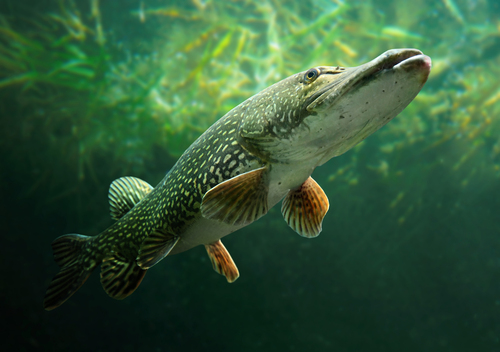
Northern Pike
Esox lucius
Meet the 'Water Wolf,' a master of camouflage and the ultimate freshwater ambush hunter. With its torpedo-like body and lightning-fast strike, the Northern Pike is a magnificent sight to behold in the underwater world.
Quick Identification
Size
Typically 16-40 inches (40-100 cm) and 2-22 lbs (1-10 kg), though trophy specimens can exceed 50 inches and 40 lbs.
Colors
Olive to dark green back fading to yellowish-white bean-shaped spots on the sides; creamy white belly and orange-tinted fins with dark markings.
Key Features
- Torpedo-shaped body with fins set far back near the tail
- Duck-bill shaped snout with hundreds of needle-sharp teeth
- Light-colored horizontal spots on a dark body background
- Highly mobile eyes positioned on top of the head for binocular vision
When You’ll See Them
Behavior
The Northern Pike is a legendary ambush predator often referred to as the 'Water Wolf.' Its primary behavioral trait is stillness; it spends long periods suspended motionless among aquatic vegetation or submerged timber, perfectly camouflaged and waiting for prey to wander too close. When a target is identified, the pike uses its rear-set dorsal and anal fins to provide a sudden, explosive burst of speed, striking its prey with a 'S-start' maneuver that is too fast for most creatures to evade.
While they are solitary and highly territorial, Northern Pike are surprisingly inquisitive. They are known to follow lures or camera equipment out of curiosity even when they aren't in a feeding mood. They are most active in cooler water, which is why they are often seen in the shallows during spring and fall, but retreat to deeper, oxygen-rich basins during the heat of mid-summer.
EverydayEarth exclusive
Camera Tips
Capturing Northern Pike on camera requires a specialized approach since they are entirely aquatic. Use a waterproof trail camera or an action camera in a dive housing. The most effective placement is near a 'transition zone'—where a weed bed meets a sandy clearing or alongside a large submerged log. Position the camera 2 to 3 feet above the lake or river floor, angled slightly upward to capture the light filtering from the surface, which helps define the pike's silhouette and spot patterns.
To draw a Pike into the camera's field of view, you can use 'visual bait.' Pike are highly attune to flash and vibration. Hanging a shiny, oversized fishing spoon or a silver spinning blade about 4-6 feet in front of the lens can pique their curiosity. As the metal catches the light, the Pike will often glide in to investigate the 'struggling' flash. If you have a dock, mounting the camera to a piling facing a known weed edge is a reliable way to catch them patrolling their territory.
Water clarity is the biggest variable for success. Aim for depths between 4 and 10 feet where sunlight still penetrates clearly. If your camera uses infrared (IR) for night shots, be aware that 'backscatter'—light reflecting off floating particles—can blur the image. To combat this, try to set the camera during periods of stable weather when the sediment has settled. Using a 'Smart IR' or 'High' shutter speed setting will help capture their lightning-fast strikes without motion blur.
Seasonal timing is critical for backyard water-viewing. In the early spring, just after the ice melts, Pike move into extremely shallow water (sometimes less than 2 feet deep) to spawn in flooded grasses and reeds. This is the best time to place a camera near the shoreline. In the winter, for those in northern climates, 'ice-cams' lowered through a hole in the ice can provide stunning, high-contrast footage of Pike moving through the crystal-clear winter water.
Similar Species
Species that look similar or are commonly confused with Northern Pike.
Frequently Asked Questions
Record Northern Pike at your habitat
Connect a camera to start building your own species record — AI identifies every visitor automatically.