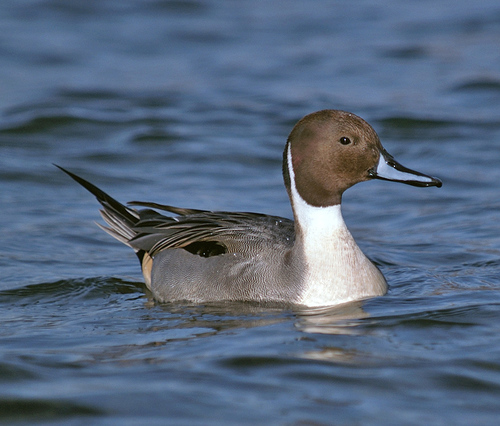
Northern Pintail
Anas acuta
The Northern Pintail is the epitome of waterfowl elegance, known for its slender neck and needle-like tail. This 'greyhound of the air' is a prized sight for backyard observers and wetland enthusiasts alike.
Quick Identification
Size
Length: 20-30 in (51-76 cm) | Wingspan: 31-37 in (80-95 cm) | Weight: 1.0-2.9 lbs (450-1,300 g)
Colors
Males have a chocolate-brown head, white breast, and a distinctive white stripe running up the side of the neck. Females are mottled tan and brown with a gray-black bill.
Key Features
- Long, pointed needle-like tail feathers in males
- Extremely slender, graceful neck
- Elegant, streamlined silhouette in flight
- Blue-gray bill with a central black stripe
When You’ll See Them
Sightings on EverydayEarth
Apr 13, 2026
A Great Egret stands patiently on the left bank of the wetland channel, while several Northern Pintails and other waterfowl forage in the shallow water and rest on the muddy shoreline. A Turkey Vulture and other smaller birds are seen flying across the sky in the background.
Apr 13, 2026
A diverse group of waterfowl and shorebirds is active in a shallow marsh channel. American Coots and various ducks, including Northern Shovelers and Pintails, swim and forage in the water. Black-necked Stilts wade through the shallows, while a Great Egret stands watch in the distance. Occasionally, groups of birds take flight across the frame, showcasing the high level of activity in the wetland.
Apr 9, 2026
A diverse group of waterfowl is active in the marsh. Dozens of American Coots swim across the open water, while several male Northern Shovelers forage nearby. A male Northern Pintail is seen swimming toward the center of the frame, and a Great Egret wades slowly along the distant shoreline to the left.
Apr 9, 2026
A diverse group of waterfowl is gathered along the muddy shoreline of a wetland. Several male Northern Shovelers and at least one Northern Pintail are resting and preening their feathers on the bank. In the water to the right, an American Coot swims slowly. The background is lush with green reeds and a dense stand of tall, blooming yellow mustard plants.
Apr 8, 2026
A diverse group of waterfowl is active in the wetland area. American Coots are scattered across the water, swimming and diving, while Northern Shovelers and Northern Pintails glide slowly through the shallows. One Northern Shoveler in the foreground provides a clear view of its distinctive broad bill.
Apr 7, 2026
A diverse group of waterfowl is seen swimming and foraging in the shallow waters of a marsh. Male Northern Shovelers are easily identified by their bright plumage and large bills as they move alongside elegant Northern Pintails. Several American Coots are also present, identifiable by their dark feathers and white bills. One bird near the center performs a brief bathing display, splashing water over its back.
Behavior
Northern Pintails are often referred to as the 'greyhounds of the air' due to their slender build and incredible speed. Unlike many other ducks that might linger near humans for handouts, Pintails are notoriously wary and skittish. They are dabbling ducks, meaning they feed by tipping their tails up and submerging their heads to reach aquatic vegetation and seeds in shallow water.
These ducks are highly social outside of the breeding season, frequently gathering in massive flocks that can number in the thousands. They are among the earliest migrants to head south in the fall and north in the spring. In flight, they are easily recognized by their thin wings and long necks, often flying in tight, fast-moving formations.
EverydayEarth exclusive
Camera Tips
Capturing the Northern Pintail on camera requires a strategy focused on stealth and wide-open spaces. Because these ducks are incredibly wary of movement, your camera must be well-camouflaged. Use local reeds, dried grasses, or burlap to break up the hard edges of the camera housing. Position the device no more than 6 to 12 inches above the water level on a sturdy stake or a low-profile float. This low angle provides a dramatic 'eye-level' perspective that showcases the male's impressive tail and slender neck profile against the water's surface.
Since Pintails prefer open water far from the shoreline to avoid predators, look for 'loafing logs' or shallow mudflats that extend into the water. These are prime locations where ducks congregate to preen and rest during the middle of the day. Set your camera's trigger speed to its fastest setting; Pintails are quick to take flight, and a slow sensor will result in many photos of empty water or just the tail end of a departing bird.
If you are setting up near a backyard pond or a flooded field, avoid using high-intensity white flashes at night, as this can spook the entire flock and prevent them from returning. Instead, rely on high-quality infrared (IR) or 'no-glow' sensors for night activity. During the day, utilize a burst mode of 3 to 5 frames per trigger. This increases your chances of capturing the moment a male 'tips up' to feed, which is one of the most iconic behaviors of the species.
For the best results, place your camera facing North or South to avoid direct lens flare during the 'Golden Hours' of sunrise and sunset. The low, warm light of early morning is particularly effective at highlighting the crisp white stripe on the male's neck and the subtle intricate patterns of the female’s feathers. If your camera supports it, the 'Time Lapse' or 'Field Scan' mode is a secret weapon for Pintails, allowing you to capture candid group behavior without needing a bird to walk directly in front of the PIR sensor.
Similar Species
Species that look similar or are commonly confused with Northern Pintail.
Mallard
Mallards are much stockier with shorter necks; males have iconic green heads rather than brown.
American Wigeon
Wigeons have a distinctive white 'baldpate' on the forehead and a much shorter, stubbier bill.
Gadwall
Gadwalls are more understated in color, lacking the long tail and white neck stripe of the Pintail.
Frequently Asked Questions
Record Northern Pintail at your habitat
Connect a camera to start building your own species record — AI identifies every visitor automatically.