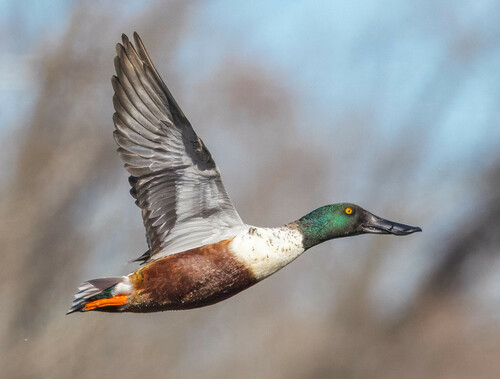
Northern Shoveler
Spatula clypeata
With a bill built like a specialized tool and a wardrobe of striking colors, the Northern Shoveler is a masterpiece of wetland evolution. Watch for their hypnotic 'pinwheel' feeding dance in shallow waters.
Quick Identification
Size
Length: 17–20 in (43–51 cm); Wingspan: 27–33 in (69–84 cm); Weight: 14–29 oz (400–822 g).
Colors
Breeding males have an iridescent dark green head, white chest, and rich chestnut flanks. Females are mottled sandy-brown with a distinct orange-bordered bill.
Key Features
- Massive, spatula-shaped bill that is longer than the head
- Striking white chest and chestnut sides on males
- Pale blue shoulder patches visible during flight
- Yellow eyes on adult males
- Mottled brown body with orange-toned bill on females
When You’ll See Them
Sightings on EverydayEarth
Apr 13, 2026
A diverse group of waterfowl and shorebirds is active in a shallow marsh channel. American Coots and various ducks, including Northern Shovelers and Pintails, swim and forage in the water. Black-necked Stilts wade through the shallows, while a Great Egret stands watch in the distance. Occasionally, groups of birds take flight across the frame, showcasing the high level of activity in the wetland.
Apr 9, 2026
A diverse group of waterfowl is active in the marsh. Dozens of American Coots swim across the open water, while several male Northern Shovelers forage nearby. A male Northern Pintail is seen swimming toward the center of the frame, and a Great Egret wades slowly along the distant shoreline to the left.
Apr 9, 2026
A group of American Coots and Northern Shovelers are active in a shallow marsh. The coots are seen swimming and occasionally diving beneath the surface, while a pair of Northern Shovelers dabble for food nearby. In the background, tall reeds and bright yellow wildflowers line the water's edge under clear daylight.
Apr 9, 2026
A diverse group of waterfowl is gathered along the muddy shoreline of a wetland. Several male Northern Shovelers and at least one Northern Pintail are resting and preening their feathers on the bank. In the water to the right, an American Coot swims slowly. The background is lush with green reeds and a dense stand of tall, blooming yellow mustard plants.
Apr 8, 2026
A diverse group of waterfowl is active in the wetland area. American Coots are scattered across the water, swimming and diving, while Northern Shovelers and Northern Pintails glide slowly through the shallows. One Northern Shoveler in the foreground provides a clear view of its distinctive broad bill.
Apr 7, 2026
A diverse group of waterfowl is seen swimming and foraging in the shallow waters of a marsh. Male Northern Shovelers are easily identified by their bright plumage and large bills as they move alongside elegant Northern Pintails. Several American Coots are also present, identifiable by their dark feathers and white bills. One bird near the center performs a brief bathing display, splashing water over its back.
Behavior
Northern Shovelers are highly social ducks known for their unique feeding behavior. Unlike many other dabbling ducks that tip their tails up to reach submerged plants, shovelers are often seen swimming with their heads partially submerged, swinging their massive bills from side to side. This action filters out tiny crustaceans and seeds from the upper layers of the water. They are frequently observed in 'pinwheel' formations, where a group of ducks swims in a tight circle to create a vortex that brings food up to the surface.
While they are relatively common in mixed-species flocks, they tend to be slightly more territorial than other ducks during the breeding season. In flight, they are steady and fast, often appearing front-heavy due to their oversized bills. They are less likely to visit dry land than Mallards, preferring to stay within the safety of shallow water where their specialized bills give them a competitive advantage.
EverydayEarth exclusive
Camera Tips
To capture the best footage of Northern Shovelers, your camera placement is everything. Because these ducks spend almost 100% of their time on the water or at the very muddy edge of a shoreline, you should mount your camera just 6 to 12 inches above the water level. A low-angle shot provides a much more intimate view of their unique bill structure and feeding 'pinwheels.' If you have a backyard pond or a nearby marsh, look for 'shallows'—areas where the water is less than 6 inches deep—as these are the prime spots where shovelers sift for food.
Since shovelers are constantly in motion while filtering water, motion-blur can be an issue. Set your camera to its highest possible shutter speed or use 'Action Mode' if available. If your AI-powered camera supports burst photos, enable it; catching the moment they lift their heads and water drips from those massive spatula bills makes for a stunning shot. Avoid pointing the lens directly toward the sun to prevent glare off the water's surface; instead, aim for a north-facing setup to get consistent, soft lighting throughout the day.
If you are trying to lure them toward a specific camera trap, focus on habitat rather than traditional birdseed. Shovelers aren't interested in cracked corn on the ground. Instead, maintaining a healthy, chemical-free pond that supports natural aquatic life like daphnia and tiny snails will keep them coming back. If your pond has a muddy 'landing strip' or a half-submerged log near a shallow edge, place your camera there, as they often use these spots to preen their feathers after a long session of filtering.
Similar Species
Species that look similar or are commonly confused with Northern Shoveler.
Mallard
Mallards have a much smaller, flatter bill and lack the bright white chest and chestnut flanks of the Shoveler.
Blue-winged Teal
Much smaller in size with a petite, narrow bill; males have a white crescent on the face rather than a green head.
Cinnamon Teal
Males have an entirely cinnamon-red body and head, lacking the Shoveler's white chest and green head.
Frequently Asked Questions
Record Northern Shoveler at your habitat
Connect a camera to start building your own species record — AI identifies every visitor automatically.