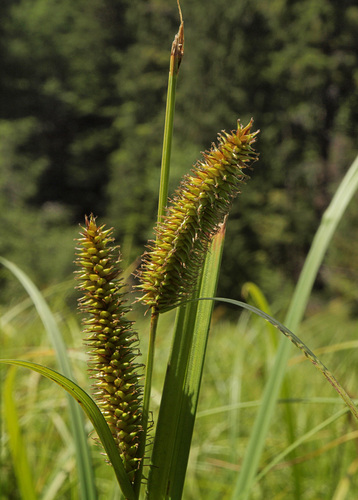
Northwest Territory sedge
Carex utriculata
A golden-green cornerstone of the North American wetland, the Northwest Territory sedge is more than just a plant—it's a bustling hub for backyard biodiversity. With its unique 'bottle-shaped' seeds and sturdy triangular stems, it provides the perfect backdrop for your aquatic wildlife photography.
Quick Identification
Size
Stems typically reach 60–120 cm (24–48 inches) in height; leaf blades are 4–12 mm (0.15–0.47 inches) wide.
Colors
Bright lime green to yellowish-green foliage; seed heads (perigynia) are pale green turning to a golden straw-yellow or light brown at maturity.
Key Features
- Distinctly triangular stems typical of sedges
- Inflated, beaked seed sacs (perigynia) that look like tiny bottles
- Spongy, often reddish-tinted base of the stem
- Forms dense, colony-like mats in wet soil
When You’ll See Them
Behavior
The Northwest Territory sedge is a foundational wetland species that acts as both a soil stabilizer and a sanctuary for aquatic life. Unlike many garden grasses, this sedge spreads vigorously through an underground network of rhizomes, eventually forming dense, lush stands that can dominate lake edges and marshy patches. It is a perennial plant, meaning it returns year after year from the same root system, providing a reliable structure for backyard ecosystems.
Ecologically, this species is a 'workhorse.' It provides critical nesting material and cover for waterfowl, while its submerged roots offer a nursery for tadpoles and aquatic insects. For the backyard enthusiast, it serves as a natural filter, cleaning runoff water before it enters ponds or streams. While it doesn't 'behave' in the animal sense, its seasonal rhythm—emerging in early spring and turning a striking golden hue in late summer—provides a beautiful visual clock for your local environment.
EverydayEarth exclusive
Camera Tips
Capturing the Northwest Territory sedge effectively requires a different approach than moving wildlife. To get the best results, place your camera on a low-profile tripod or a ground mount. Position the lens about 12 to 18 inches from the ground, angled slightly upward. This 'frog’s eye view' emphasizes the architectural beauty of the triangular stems and makes the inflated seed heads stand out against the sky or the water's surface.
Because this sedge is a magnet for other species, setting your camera to a 'Time-Lapse' or 'Hybrid' mode (photo + video) is highly effective. If your AI camera has a high-sensitivity trigger, place it near the base of a sedge cluster to catch the amphibians, like tree frogs or salamanders, that use the spongy stems for moisture and cover. Avoid using heavy baits which might rot in the wet soil; instead, let the plant itself be the lure for local herbivorous birds and insects.
Lighting is your best friend when photographing this species. The yellowish-green leaves are particularly translucent; try to position your camera so the morning or late afternoon sun 'backlights' the sedge. This creates a glowing effect and clearly defines the 'beak' of the seed sacs, which is a key identification feature. In windy conditions, use a fast shutter speed (1/500 or higher) to freeze the motion of the waving seed heads, or a very slow shutter speed to create a soft, artistic blur of green and gold.
Seasonality plays a huge role in your camera strategy. In late spring, focus on the bright green emerging shoots. By mid-summer, the focus should shift to the heavy, drooping seed heads. During the winter, even when the plant is dormant and brown, it creates a striking contrast against snow or dark mud, making it an excellent foreground subject for capturing wintering birds that scavenge for leftover seeds within the dried husks.
Frequently Asked Questions
Record Northwest Territory sedge at your habitat
Connect a camera to start building your own species record — AI identifies every visitor automatically.