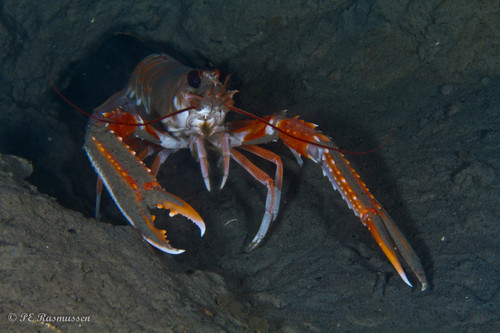
Norway lobster
Nephrops norvegicus
Meet the architect of the deep-sea mudflats. The Norway lobster is a vibrant, coral-colored master of the Atlantic floor, known for its complex tunnels and delicate, elongated claws.
Quick Identification
Size
Grows up to 25 cm (10 in) long, with males typically larger than females.
Colors
Uniformly pale orange or coral pink; some populations show slightly darker reddish bands on the claw joints.
Key Features
- Slim, elongated claws with longitudinal ridges
- Bright coral or pale orange exoskeleton
- Large, dark, kidney-shaped eyes
- Telson with fine hairs and spines
When You’ll See Them
Behavior
Norway lobsters are solitary and industrious engineers of the seafloor. They spend the vast majority of their lives inside complex, U-shaped burrow systems excavated in soft mud or silty clay. These tunnels can be quite extensive, reaching depths of 30 centimeters and often featuring multiple ventilation holes and exits to allow for quick escapes from predators.
These crustaceans are highly sensitive to light levels, which dictates their daily rhythm. In shallower waters, they are strictly nocturnal, only emerging from their burrows under the cover of darkness. In deeper, darker waters, they may be active during the day. They are territorial regarding their burrows but generally peaceful unless competing for space or during the mating season, when males can become more aggressive toward one another.
EverydayEarth exclusive
Camera Tips
Capturing the Norway lobster on camera is a specialized endeavor that requires a waterproof, deep-sea rated camera system or a submersible ROV (Remotely Operated Vehicle). Because these animals live on the seafloor, you should aim to place your camera on a weighted tripod or sled that can sit level on soft mud. Look for the characteristic mounds of excavated silt or 'U-shaped' openings that indicate an active burrow system. Placing the camera roughly 1 to 2 feet from a burrow entrance provides the best angle for observing an emergence.
Light management is the most critical factor for a successful 'shot.' Norway lobsters have extremely light-sensitive eyes adapted for the murky depths; a standard white LED floodlight will likely cause them to retreat immediately. Use infrared (IR) or red-light filters on your equipment to observe their natural foraging behavior. This 'stealth' lighting allows you to see them without disturbing their nocturnal cycle, ensuring you capture them as they actively sift through the mud for food.
To guarantee an appearance in front of the lens, use a scent-based lure. A mesh bait bag filled with crushed, oily fish such as mackerel or sardines is highly effective. Secure the bait bag directly in the camera's field of view, ideally about 18 inches away from the lens to ensure the lobster stays in focus while it investigates the smell. Check your equipment during the late summer months, as increased activity during the breeding season often leads to more frequent sightings outside of their tunnels.
Similar Species
Species that look similar or are commonly confused with Norway lobster.
Frequently Asked Questions
Record Norway lobster at your habitat
Connect a camera to start building your own species record — AI identifies every visitor automatically.