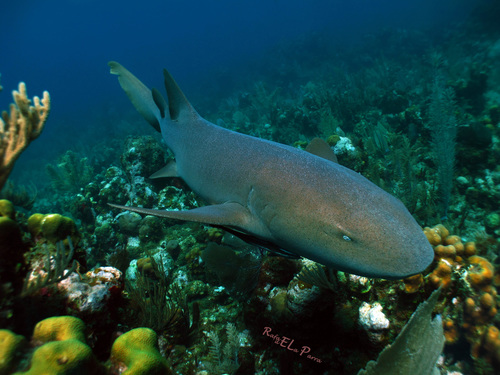
Nurse Shark
Ginglymostoma cirratum
The nurse shark is a master of the seafloor, known for its peaceful daylight huddles and impressive nocturnal hunting skills. With its distinctive barbels and vacuum-like feeding, this shark is a fascinating neighbor for those living along tropical coastlines.
Quick Identification
Size
Typically 7.5 to 9 feet (2.3 to 2.7 meters) in length; weight ranges from 150 to 300 pounds (68 to 136 kg).
Colors
Uniform brownish-tan to yellowish-brown body; juveniles may display small dark spots that fade with age.
Key Features
- Two rounded dorsal fins of nearly equal size located far back on the body
- Fleshy barbels (whisker-like organs) hanging near the nostrils
- Broad, flattened head with a very small mouth
- Long caudal fin (tail) that can be up to one-fourth of the total body length
When You’ll See Them
Sightings on EverydayEarth
Jun 16, 2026
A pair of Spotted Eagle Rays glides gracefully through the open water, showcasing their striking white-spotted patterns. The camera then captures a busier scene along the reef where a group of Nurse Sharks is seen swimming together. They are surrounded by active schools of fish, including Yellowtail Snappers and Bar Jacks, moving among the colorful coral and sea fans.
Mar 31, 2026
A large nurse shark is the primary focus, first seen nestled within the reef structure and later swimming gracefully across a sandy clearing near the sea floor. Numerous small reef fish, including bluehead wrasse, are active throughout the scene, darting between sea fans and coral heads. The water is clear with visible sunlight filtering down from the surface.
Behavior
Nurse sharks are often described as the 'couch potatoes' of the sea. Unlike many shark species that must swim constantly to breathe, nurse sharks possess a buccal pumping mechanism that allows them to remain stationary on the sea floor while actively pumping water over their gills. During the day, they are highly social and are frequently found resting in 'sleep piles' of up to 40 individuals, often tucked under rocky ledges or within coral crevices.
As nocturnal hunters, nurse sharks become solitary and active after sunset. They use their sensitive barbels to sift through the sand and rubble, detecting hidden prey through scent and touch. While they are generally sluggish and docile toward humans, they have a powerful bite and will defend themselves if stepped on or provoked. They exhibit strong site fidelity, often returning to the same specific cave or ledge to rest day after day.
EverydayEarth exclusive
Camera Tips
To capture high-quality footage of a nurse shark with an underwater trail camera or a stationary action camera, placement is everything. These are benthic (bottom-dwelling) animals, so your camera should be mounted within 12 to 24 inches of the seabed. Look for 'high-traffic' areas such as the mouth of a coral cavern, the underside of a coastal dock, or a narrow channel between mangrove roots. Angle the lens slightly downward to ensure you catch the shark's face as it 'walks' along the bottom using its pectoral fins.
Since nurse sharks rely heavily on their sense of smell, using a scent lure is the most effective way to guarantee a 'visit' to your camera. Place a perforated bait box containing oily fish like mullet or mackerel about 3 to 5 feet in front of the lens. The sharks will follow the scent trail and often spend several minutes investigating the source, providing excellent opportunities to record their unique suction-feeding behavior and the movement of their sensory barbels.
Lighting is a critical factor for these nocturnal creatures. While white light can sometimes startle marine life, nurse sharks are relatively hardy. However, for the most natural behavior, use a camera equipped with high-intensity infrared (IR) LEDs. If you are filming in a backyard canal or near a dock, ensure the camera is weighted properly or secured to a pylon; the powerful suction and movement of a 200-pound shark can easily knock over an unsecured tripod or mount.
Finally, maintenance in saltwater is vital. Ensure your camera housing is rated for the depth and salt exposure. After every deployment, soak the entire unit in fresh water for at least 30 minutes to dissolve salt crystals that can ruin seals. Check the tide charts before setting your gear; the best footage usually occurs during high tide when sharks move into shallower areas to forage, or during the slack tide when water clarity is at its peak.
Similar Species
Species that look similar or are commonly confused with Nurse Shark.
Lemon Shark
Lemon sharks have more pointed, triangular fins and a distinct yellowish tint to their skin, whereas nurse sharks are browner and have rounded fins.
Sand Tiger Shark
Sand tigers have a more jagged, toothy appearance even when their mouths are closed, while nurse sharks have very small, inconspicuous mouths.
Frequently Asked Questions
Record Nurse Shark at your habitat
Connect a camera to start building your own species record — AI identifies every visitor automatically.