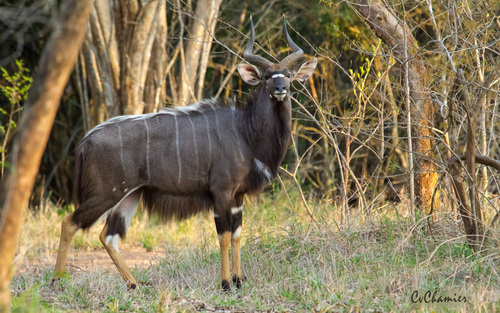
Nyala
Tragelaphus angasii
With their striking stripes and majestic spiral horns, the Nyala is widely considered the most beautiful antelope in Southern Africa. These 'shadow-dwellers' are a prize for any backyard camera enthusiast, offering a glimpse into the secret life of the African bush.
Quick Identification
Size
Length: 135–195 cm (4.4–6.4 ft); Shoulder Height: 90–115 cm (3–3.8 ft); Weight: 55–125 kg (121–276 lbs)
Colors
Males are dark charcoal or slate grey with yellow 'stockings' on legs; females and juveniles are bright rusty-orange with distinct white vertical stripes.
Key Features
- Spiral horns with white tips (males only)
- 10-14 white vertical stripes on the flanks
- Long, shaggy mane and underbelly fringe on males
- Large, white-tipped ears and white chevron between the eyes
When You’ll See Them
Sightings on EverydayEarth
Jul 2, 2026
A quiet nighttime scene at the Hoedspruit Endangered Species Centre. A large White Rhinoceros is resting on the ground in the shadows to the right, while two Nyala are lying down in the clearing nearby. A small insect flies across the left side of the frame early in the footage.
Jun 26, 2026
A peaceful nighttime scene in the woodland clearing shows two animals resting. On the left, a Bush Duiker sits alert on the ground, occasionally turning its head. Nearby, a juvenile Nyala is curled up, with its distinctive white stripes visible against its coat.
Jun 21, 2026
A quiet nighttime scene shows a Nyala resting in the center of the clearing, occasionally turning its head to monitor the area. On the right edge of the frame, a White Rhinoceros is partially visible, either resting or slowly grazing. A third, distant animal can be seen lying down in the background to the left.
Jun 20, 2026
Under the cover of night, a massive rhinoceros enters the frame from the right, moving slowly across the clearing. In the background near the treeline, a pair of nyala are active, their distinctive striped leg markings visible as they walk through the shadows.
Jun 18, 2026
A Nyala is seen resting on the ground in the lower right of the frame. It remains alert throughout the sequence, with its head raised and ears twitching as it looks around the darkened woodland clearing.
Jun 18, 2026
A quiet night in the South African woodland sees activity from two different antelope species. A Bush Duiker walks across the clearing in the background, moving from right to left, while a Nyala stands still and alert in the foreground, its white leg markings clearly visible in the infrared light.
Behavior
Nyala are remarkably shy and elusive antelopes that prefer the safety of dense thickets over open grasslands. Unlike many other African bovids, they are not territorial; instead, they occupy overlapping home ranges. Females and their offspring usually form small, cohesive groups, while males tend to be more solitary or form loose, non-hierarchical bachelor associations until they reach maturity.
These animals are highly cautious and possess an acute sense of hearing and smell. They spend a significant portion of their day hidden in deep cover to avoid predators, emerging primarily during the cooler crepuscular hours. When startled, they emit a deep, dog-like alarm bark that warns others in the area of impending danger. In residential areas where they have become habituated, they can be surprisingly bold, though they remain ready to retreat into the shadows at a moment's notice.
EverydayEarth exclusive
Camera Tips
To capture high-quality footage of Nyala, camera placement should focus on 'edge habitats'—the boundary where thick bush meets a clearing or a garden lawn. Nyala are hesitant to step into wide-open spaces, so position your camera near the exit points of known game trails. Mounting the camera at a height of 3 to 4 feet (approx. 1 meter) is ideal, as this aligns with their mid-section and ensures you capture the impressive spiral horns of the males as well as the delicate features of the females.
Lighting and flash settings are critical for this species. Because they are most active during the 'golden hours' of dawn and dusk, ensure your camera has a fast trigger speed to handle the low-light transitions. Use 'No-Glow' or 'Black LED' infrared flashes whenever possible. Nyala are extremely sensitive to the faint red glow of standard IR cameras and may avoid the area if they feel watched. A silent shutter is also a massive advantage, as the mechanical 'click' of some older cameras will cause them to look directly at the lens or flee.
If you are looking to attract them to a specific spot for your camera, water is the best lure. A low-to-the-ground water basin or a small garden pond in a quiet, shaded corner will almost certainly become a regular stop on their daily route. They are also highly attracted to fallen fruit, particularly from indigenous trees like the Marula or Cape Ash. Setting your camera to video mode for 20-30 second clips is highly recommended; this allows you to observe their cautious grooming behaviors and the dramatic display of the male's dorsal hair, which he fans out like a white 'sail' when asserting dominance.
Similar Species
Species that look similar or are commonly confused with Nyala.
Frequently Asked Questions
Record Nyala at your habitat
Connect a camera to start building your own species record — AI identifies every visitor automatically.