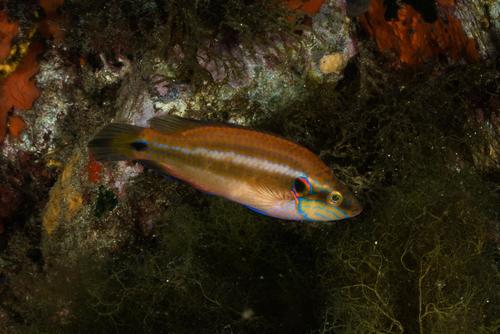
Ocellated Wrasse
Symphodus ocellatus
The Ocellated Wrasse is the Mediterranean's most diligent architect, famous for building complex algae nests. Its striking 'eye-spot' and vibrant personality make it a favorite for coastal underwater explorers.
Quick Identification
Size
Maximum length of 12 cm (4.7 in); typically averages 6-10 cm (2.4-3.9 in)
Colors
Males are vibrant greenish-brown with a distinct orange/red spot edged in blue on the gill cover; females and juveniles are more muted beige or brown with two dark horizontal stripes.
Key Features
- Distinct 'eye-spot' (ocellus) on the gill cover edged in bright blue
- Small, pointed mouth adapted for picking invertebrates
- Two dark longitudinal bands running from head to tail (more prominent in females)
- Compact, oval-shaped body with a single long dorsal fin
When You’ll See Them
Behavior
The Ocellated Wrasse is one of the most socially complex small fish you can observe in Mediterranean waters. Unlike many other small reef fish, they exhibit fascinating breeding behaviors centered around nest-building. Dominant males spend significant energy harvesting various species of algae to construct elaborate mounds where females lay their eggs. This 'architectural' phase is a highlight for anyone watching via an underwater camera, as the males are tireless in their pursuit of the perfect piece of seaweed.
Beyond their construction skills, their social hierarchy is intriguing. In any given population, you might find three types of males: the large territorial males who build and guard nests, 'satellite' males who help defend the nest in exchange for a chance to spawn, and 'sneaker' males who mimic females to get close to the eggs. They are generally peaceful but can be quite territorial around their nests, darting at intruders to protect their future brood.
EverydayEarth exclusive
Camera Tips
To capture the Ocellated Wrasse on an underwater 'backyard' camera, placement is everything. Look for rocky outcrops that transition into seagrass beds at a depth of about 1 to 3 meters. If you spot a small mound of multi-colored algae that looks 'placed' rather than grown, you've found a nest. Position your camera about 50 cm (20 inches) from this mound, angled slightly upward to catch the light. Using a weighted tripod or a suction mount on a flat rock is essential to prevent the camera from shifting with the tide or surge.
Because these fish are highly visual, lighting is your best friend. Choose a day with clear water and high sun to bring out the iridescent blues and oranges on the male’s gill covers. If you are filming in an area with a lot of particulate matter, a red filter can help restore the color balance that is lost even in shallow water. For the most natural behavior, leave the camera stationary for at least 30 minutes; the wrasse will eventually ignore the device and return to its busy schedule of nest maintenance and courtship.
If you want to draw them in for a close-up, a 'lure' of crushed mussel or sea urchin tucked into a rock crevice near the lens works wonders. However, avoid overfeeding, as this can attract larger predators like sea bass that might scare the wrasse away. Set your camera to a high frame rate (at least 60fps) because these fish move in quick, jerky bursts—slowing down the footage later will reveal the intricate 'shiver' dance the males perform to attract females.
Similar Species
Species that look similar or are commonly confused with Ocellated Wrasse.
Frequently Asked Questions
Record Ocellated Wrasse at your habitat
Connect a camera to start building your own species record — AI identifies every visitor automatically.