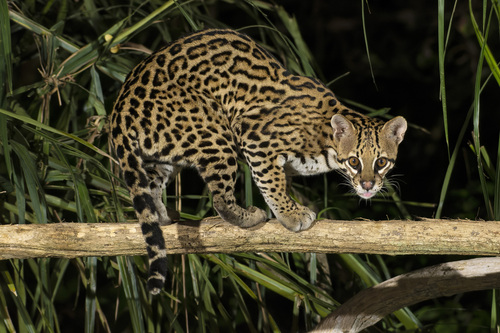
Ocelot
Leopardus pardalis
Often called the most beautiful cat in the world, the ocelot is a master of the night. With its mesmerizing chain-like rosettes and secretive nature, seeing one on camera is the ultimate prize for any wildlife enthusiast.
Quick Identification
Size
Body length 70–100 cm (28–40 in), tail 30–45 cm (12–18 in); weighs 7–15.5 kg (15–34 lbs)
Colors
Tawny or golden coat adorned with chain-like black spots and rosettes; white underbelly; two black streaks on cheeks
Key Features
- Chain-like black rosettes running horizontally along the body
- Two prominent black stripes on each cheek
- Short, rounded ears with a distinct white 'eye' spot on the back
- Long, ringed tail roughly one-third of the total body length
When You’ll See Them
Behavior
Ocelots are solitary and highly territorial predators that spend the majority of their lives under the protection of dense canopy or thick brush. Unlike many other small cats, they are quite comfortable in the water and are capable swimmers, though they primarily hunt on the ground. They are master stalkers, using their incredible camouflage to blend into the dappled light of the forest floor, where they move with a fluid, silent grace.
While ocelots are mostly reclusive and avoid human contact, they are known to be highly efficient hunters with a high success rate. They communicate through scent marking and low-frequency vocalizations that can travel through thick vegetation. Because they require significant cover to feel safe, they are rarely seen in open fields, preferring to stick to 'wild corridors' where they can travel unseen between hunting grounds.
EverydayEarth exclusive
Camera Tips
To capture the 'ghost of the brush' on a trail camera, placement is your most critical factor. Ocelots are notoriously shy of open spaces, so you should avoid placing your camera in clearings. Instead, look for natural 'pinch points' where dense vegetation narrows near a water source or along an established game trail. They often use the same paths repeatedly to patrol their territory, so look for tracks or scat to identify these high-traffic feline highways.
Because ocelots are low-slung, mount your camera lower than you would for a deer—aim for about 12 to 18 inches off the ground. Angle the camera slightly upward or place it at a distance of 10-15 feet from the trail to ensure you capture the full length of the cat. Their horizontal rosettes are their most identifying feature, and a camera placed too close might only catch a blur of fur or a single spot.
Since they are primarily nocturnal, 'no-glow' or black flash infrared cameras are a must. Ocelots have extremely sensitive vision and a standard red-glow or white flash can spook them, causing them to avoid the area for weeks. Set your camera to take a 3-shot burst or a 15-second video clip. Ocelots move with a steady, rhythmic gait, and a single still photo often results in a 'ghost' image or just a tail exiting the frame.
While we never recommend using food bait, which can disrupt natural hunting behaviors or attract unwanted predators, curiosity-based scent lures can be effective. A small amount of a pungent scent (like a fatty-acid tablet or even certain musky perfumes) applied to a nearby log can cause an ocelot to pause and sniff, giving your camera the extra second it needs to trigger and focus. Be patient; ocelots have large territories and may only pass a specific spot once every few weeks.
Similar Species
Species that look similar or are commonly confused with Ocelot.
Bobcat
The bobcat has a very short, stubby tail and tufted ears, whereas the ocelot has a long tail and rounded ears.
Margay
The margay is smaller with much larger eyes and a tail that is longer than its body, designed for a life spent mostly in trees.
Jaguarundi
Jaguarundis have a solid, unspotted coat (either charcoal grey or reddish-brown) and a more weasel-like appearance.
Frequently Asked Questions
Record Ocelot at your habitat
Connect a camera to start building your own species record — AI identifies every visitor automatically.