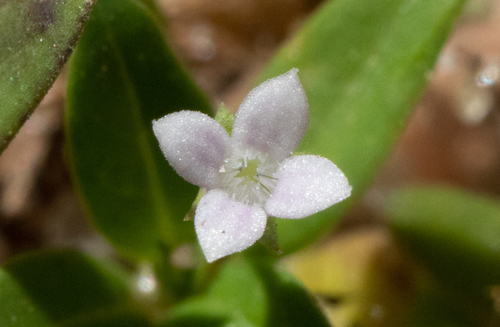
Old World Diamond Flower
Oldenlandia corymbosa
Discover the hidden beauty of your lawn with the Old World Diamond Flower, a resilient herb celebrated for its tiny, star-like blossoms and ancient medicinal history.
Quick Identification
Size
Stems reach 10–40 cm (4–16 inches) in length; flowers are tiny, approximately 2 mm (0.08 inches) wide.
Colors
Bright green foliage; small white to pale lavender flowers with four petals and yellow centers.
Key Features
- Tiny, four-petaled white or pinkish flowers
- Opposite, linear leaves with prominent stipules
- Spreading or ascending branching stems
- Flowers often grow in pairs or small clusters called corymbs
When You’ll See Them
Behavior
The Old World Diamond Flower is a resilient, low-growing herbaceous plant that often thrives in the gaps where other plants struggle. It is known for its spreading growth habit, frequently forming delicate green mats across open soil. While it may appear fragile, it is a pioneer species that quickly colonizes disturbed ground, making it a common sight in backyard gardens, cracks in pavement, and along the edges of cultivated fields.
As a member of the Rubiaceae family, this plant plays a quiet but vital role in its ecosystem. It is primarily heliophilic, meaning it seeks the sun, and its tiny blossoms typically open fully during the brightest parts of the day. Unlike many garden showstoppers, the Diamond Flower's "behavior" is one of subtle persistence, providing essential ground cover that helps retain soil moisture and prevents erosion in micro-habitats.
EverydayEarth exclusive
Camera Tips
Capturing the Old World Diamond Flower requires a different approach than traditional wildlife. Because the flowers are diminutive—often no larger than a grain of rice—you should position your camera at ground level. A macro lens or a camera with a high-resolution sensor is essential for capturing the delicate geometry of the four-petaled blossoms. Angle the camera slightly upward to catch the underside of the flowers against the sky for a dramatic silhouette, or keep it top-down to showcase the "corymb" (flat-top) cluster structure.
Since these plants are most active during the peak of the day, set your camera's interval timer to trigger between 10 AM and 2 PM. This is when the blossoms are most likely to be fully open and facing the sun. Avoid using a heavy flash, which can wash out the subtle whites of the petals; instead, use a small reflector or rely on natural diffused sunlight for a softer, more professional look. If your camera supports time-lapse photography, this is a fantastic species to document; a 24-hour cycle can reveal the plant's nyctinastic movements (how the leaves or flowers react to the transition from day to night).
While the plant itself is stationary, it is a magnet for tiny pollinators. To capture high-quality wildlife interaction, focus on a healthy cluster of flowers and wait for small hoverflies or bees. Use a fast shutter speed (at least 1/500s) if you have an AI-triggering system, as these insects move rapidly. Placement near a water source or a damp garden patch will increase the health of the plant, leading to more vibrant green stems and more frequent flowering cycles for your camera to document.
Similar Species
Species that look similar or are commonly confused with Old World Diamond Flower.
Frequently Asked Questions
Record Old World Diamond Flower at your habitat
Connect a camera to start building your own species record — AI identifies every visitor automatically.