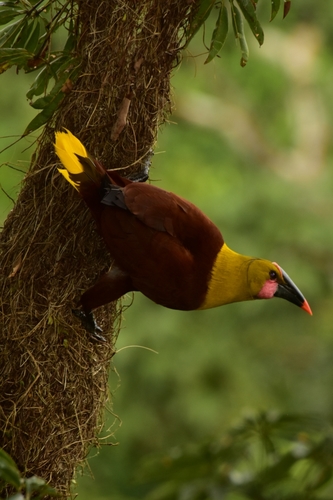
Olive Oropendola
Psarocolius bifasciatus
Meet the architect of the Amazonian canopy. As South America's largest songbird, the Olive Oropendola dominates the skyline with its massive woven nests and prehistoric, liquid calls.
Quick Identification
Size
Length: 38-53 cm (15-21 in); Weight: 200-550g (7-19 oz). Males are significantly larger than females.
Colors
Olive-green body with dark chestnut wings; bright yellow outer tail feathers; ivory-colored bill with a red tip; pale pinkish or bluish bare facial skin.
Key Features
- Massive ivory-colored bill with reddish tip
- Bright yellow outer tail feathers visible in flight
- Large bare skin patches on the cheeks
- Heavyweight passerine, significantly larger than other blackbirds
- Long, pendulous woven nests.
When You’ll See Them
Behavior
Olive Oropendolas are the undisputed heavyweights of the South American songbird world. Highly social and vocal, they are best known for their incredible colonial nesting habits. A single 'colony tree' may host dozens of three-foot-long woven nests that dangle from the tips of branches like giant teardrops. This strategy helps protect their young from climbing predators, as the thin branches cannot support the weight of a monkey or a large snake.
Their social structure is fascinatingly complex, revolving around a dominant male who defends a harem of females. To maintain his status, the male performs an acrobatic display: he bows forward until he is almost upside down, fanning his golden tail feathers and emitting a bizarre, liquid gurgling sound that resembles water pouring out of a bottle. Despite their large size, they are incredibly agile in the canopy, often hanging upside down to reach fruit or probe into bromeliads for insects.
EverydayEarth exclusive
Camera Tips
Capturing the Olive Oropendola requires thinking vertically. Because they spend the vast majority of their time in the mid-to-upper canopy, a camera placed at eye level on the ground will rarely see them unless they descend for water. For the best results, mount your AI-powered camera on a high balcony, a second-story deck, or a sturdy limb overlooking a clearing. Position the camera at a slightly downward angle to capture the vibrant yellow of their tail feathers and the unique profile of their massive ivory bills against the green canopy.
If you are lucky enough to have a nesting colony nearby, place your camera at a distance with a clear line of sight to the hanging nests. Do not attempt to mount cameras directly on the nest tree during the breeding season, as these birds are sensitive to disturbance near their young. Use a fast shutter speed or high frame rate (at least 60fps); their 'bowing' display is incredibly rapid and can look like a blur on standard settings. Setting the trigger sensitivity to high is recommended, as these birds move with a surprising amount of speed and force for their size.
To attract them closer to a backyard setup, utilize their love for high-energy food. A large, sturdy platform feeder—not a hanging one—stocked with overripe bananas, halved papayas, or even suet-like mixes can entice them. Because they are the heavyweights of the songbird world, ensure your feeder or camera mount is exceptionally stable; the landing of a half-kilogram bird will cause significant 'camera shake' on flimsy setups. Early morning light is best for highlighting the subtle olive and chestnut tones of their plumage, so aim your lens toward the west to catch the rising sun's glow on the bird's front.
Similar Species
Species that look similar or are commonly confused with Olive Oropendola.
Frequently Asked Questions
Record Olive Oropendola at your habitat
Connect a camera to start building your own species record — AI identifies every visitor automatically.