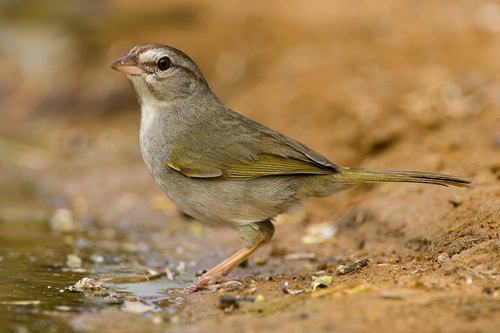
Olive Sparrow
Arremonops rufivirgatus
A secretive resident of the southern brushlands, the Olive Sparrow is a splash of subtle color in the thickets. Known for its 'bouncing ball' song and shy nature, it is a prized find for any backyard bird photographer.
Quick Identification
Size
Length: 14–15.5 cm (5.5–6.1 in); Wingspan: 20–23 cm (8–9 in); Weight: 22–29 g (0.8–1.0 oz)
Colors
Dull olive-green back, wings, and tail; greyish-white underparts; grey head with two prominent brown stripes on the crown and through the eye. Sexes look identical.
Key Features
- Olive-green plumage on the upperparts
- Two distinct brown stripes on a grey head
- Short, thick conical bill
- Usually seen low to the ground in dense brush
When You’ll See Them
Behavior
The Olive Sparrow is a master of the thicket, preferring to spend its time deep within tangled brush rather than out in the open. It is a shy and secretive species, often detected only by its distinctive song—a series of sharp chips that accelerate like a bouncing ball. Unlike many other sparrows that form large winter flocks, Olive Sparrows are typically found alone or in pairs, maintaining territories year-round in the warmer parts of their range.
When foraging, they use a classic 'double-scratch' method, hopping forward and then jumping back to kick away leaf litter and uncover hidden insects or seeds. While they are cautious, they can become quite comfortable in backyard settings if provided with enough cover. They rarely fly long distances, preferring to hop between branches or move through the undergrowth to escape perceived threats.
EverydayEarth exclusive
Camera Tips
To successfully capture an Olive Sparrow on your backyard camera, focus on 'edge habitats.' These birds are extremely reluctant to cross wide-open spaces, so place your camera where a lawn meets a dense hedge or brush pile. Position the camera very low—ideally 6 to 12 inches off the ground—and angle it slightly upward to capture the bird's profile as it scratches through the dirt. Because they blend in so well with green foliage, try to aim the camera toward a patch of brown leaf litter or mulch to help the bird stand out in the frame.
Luring Olive Sparrows is best done with ground-level offerings. Avoid hanging feeders, which they rarely use. Instead, scatter white proso millet or a finely cracked corn mix directly on the ground in a sheltered spot. Even better than food is water; a shallow, ground-level birdbath placed near cover is an irresistible draw for this species. They are enthusiastic bathers, and the motion of splashing water often triggers the camera's motion sensor more reliably than the bird's subtle movements alone.
Set your camera to a high-sensitivity trigger and use burst mode or short video clips (15 seconds). Olive Sparrows move with quick, jerky hops, and a single photo often results in a blurred tail or a bird halfway out of the frame. Video is particularly rewarding as it captures their unique 'tail-pump' and the rhythmic way they search for food. If your camera has adjustable PIR (Passive Infrared) settings, keep it on 'High' because these birds are small and their body heat may not always trigger the sensor through dense shadows.
Pay attention to the lighting. Because of their olive and grey tones, these birds can look like 'blobs' in deep shade or under harsh midday sun. The best footage usually comes in the early morning when the sun is at a low angle. Position your camera facing north or south to avoid direct lens flare, ensuring the subtle green of their wings is properly illuminated. In South Texas and Mexico, where they are year-round residents, keep your camera active through the spring nesting season when they are most active and likely to bring fledglings to your feeding area.
Similar Species
Species that look similar or are commonly confused with Olive Sparrow.
Frequently Asked Questions
Record Olive Sparrow at your habitat
Connect a camera to start building your own species record — AI identifies every visitor automatically.