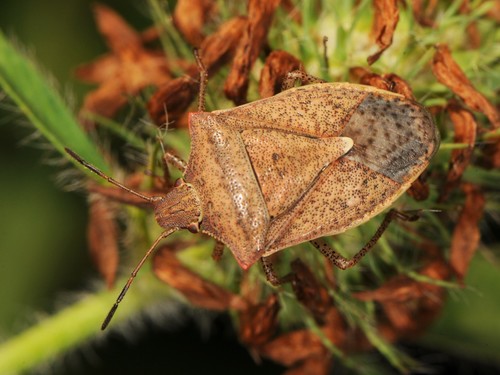
One-spotted Stink Bug
Euschistus variolarius
A common but often overlooked resident of North American gardens, the One-spotted Stink Bug is a marvel of natural camouflage and defensive chemistry. Easily identified by the male's unique abdominal marking, this shield-shaped insect is a fascinating subject for macro photography.
Quick Identification
Size
11-15 mm (0.43-0.59 inches) in length; approximately 7-9 mm in width
Colors
Dull yellowish-brown to grayish-tan upper body; light green or pale yellow underside. Males feature a distinct, small black spot on the ventral side of the abdomen near the tip.
Key Features
- Shield-shaped body typical of the Pentatomidae family
- Male has a single small black spot on the underside of the abdomen
- Pointed or slightly rounded 'shoulders' (pronotal humeri)
- Fine black dots or punctations across the back
When You’ll See Them
Behavior
The One-spotted Stink Bug is a master of camouflage, blending effortlessly into dried leaves, bark, and soil. Like its relatives, it is best known for its chemical defense system; when disturbed or crushed, it releases a pungent, almond-like odor from specialized glands to discourage predators like birds and spiders. While often seen as a solitary wanderer, you may find them in small clusters where food is particularly abundant, such as on a ripening head of grain or a sunflower.
In the backyard, they move with a slow, deliberate crawl, though they are capable fliers when searching for new host plants or mates. They are not aggressive toward humans and do not bite or sting. As the weather cools in late autumn, they exhibit a 'seeking' behavior, looking for tight crevices in tree bark, leaf litter, or even house siding to hibernate through the winter months, emerging only when the ground thaws in spring.
EverydayEarth exclusive
Camera Tips
To successfully capture a One-spotted Stink Bug on your backyard camera, you must focus on 'micro-habitats.' Because these insects are small, standard trail cameras often miss them unless they have a macro lens or a very short focal range. Position your camera just 6 to 10 inches away from a potential feeding site. Sunflowers, tomato plants, or tall ornamental grasses are excellent choices. Using a flexible 'gorilla-pod' style tripod allows you to angle the camera downward onto a leaf or upward toward a flower head where the bugs are likely to perch.
Since the One-spotted Stink Bug is most active during the warmth of the day, set your camera to take high-resolution stills or short video clips during daylight hours. If your camera has a 'time-lapse' mode, this can be an effective way to monitor a specific plant for activity over several hours without relying on a motion trigger, which might be too insensitive for an insect. To get the best identification shot, try to position the camera so it captures the side profile or the underside of the bug; the eponymous 'spot' is located on the belly of the male, which is a prize shot for any backyard naturalist.
You can encourage these bugs to visit a specific 'stage' for your camera by providing a natural lure. A sliced apple or a bruised peach placed on a flat, sun-drenched stone can act as a feeding station. Ensure the camera is level with the fruit to capture the bug's piercing-sucking mouthparts in action. In the late summer and early fall, look for them on the sunny side of your house or fence; placing a camera near these warm surfaces can catch them as they congregate before winter hibernation.
Lastly, consider the lighting. Harsh midday sun can wash out the subtle tan and brown mottling of their shells. Positioning your camera so the sun is behind it, or slightly to the side, will highlight the texture of the 'punctations' (small pits) on their back, which is a key identifying feature. If your camera has adjustable PIR (Passive Infrared) sensitivity, set it to the highest level, though be prepared for 'false triggers' from moving leaves.
Similar Species
Species that look similar or are commonly confused with One-spotted Stink Bug.
Brown Marmorated Stink Bug
Features distinct white bands on the antennae and a marbled (marmorated) pattern on its back; lacks the single black spot on the underside.
Brown Stink Bug
Very similar in color but typically has more sharply pointed 'shoulders' and the male lacks the specific black spot on the pygophore.
Frequently Asked Questions
Record One-spotted Stink Bug at your habitat
Connect a camera to start building your own species record — AI identifies every visitor automatically.