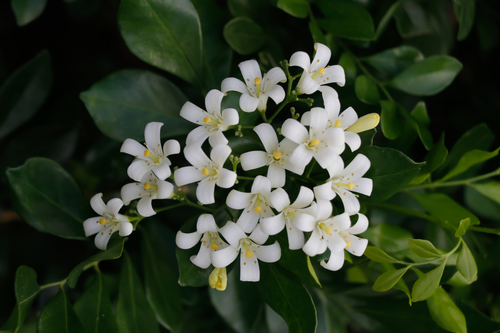
Orange Jasmine
Murraya paniculata
Famed for its intoxicating fragrance and glossy evergreen leaves, the Orange Jasmine is more than just a hedge—it's a thriving hub for pollinators and songbirds. Whether in full bloom or covered in bright red berries, this versatile shrub brings a touch of the tropics to any backyard.
Quick Identification
Size
Typically grows as a shrub or small tree reaching 3–7 metres (10–23 feet) in height, with a canopy spread of 2.5–4 metres (8–13 feet).
Colors
Glossy, deep green foliage; brilliant white or cream-colored flowers; berries that transition from green to vibrant orange-red when ripe.
Key Features
- Intense orange-blossom fragrance from 5-petaled white flowers
- Glossy, evergreen pinnate leaves with 3-7 egg-shaped leaflets
- Small, oval orange-to-red berries containing hairy seeds
- Smooth, pale grey to off-white bark on mature stems
When You’ll See Them
Behavior
Orange Jasmine is a hardy, evergreen shrub beloved for its prolific flowering cycles and its intoxicating, honey-sweet scent that mimics orange blossoms. In the wild, it grows as an understory plant in rainforests, but in suburban settings, it is a popular choice for dense privacy hedges. It responds exceptionally well to pruning, which encourages thicker growth and more frequent blooming throughout the year, especially after heavy rainfall.
While the plant itself is stationary, it acts as a central hub for backyard biodiversity. It is a primary host plant for several swallowtail butterfly species and attracts a wide variety of honeybees and nocturnal moths with its nectar. As the flowers fade, the plant produces bright red berries that serve as a vital food source for fruit-eating birds like bulbuls and silvereyes, who help disperse the seeds across the landscape.
EverydayEarth exclusive
Camera Tips
To capture the best images of Orange Jasmine, position your camera at a mid-range height (about 3-4 feet) to focus on the flower clusters or the ripening berries. Since the white petals are highly reflective, avoid using a direct flash at night which can 'blow out' the details; instead, rely on natural morning light or an off-camera LED for a softer glow. Setting your camera to a macro or close-up mode will help highlight the delicate yellow stamens inside the blossoms.
If you want to document the wildlife this plant attracts, set your camera's trigger to its most sensitive setting or use a high-speed video mode. During the day, you'll likely capture butterflies and bees visiting the nectar-rich flowers. To see who is eating the berries, aim your camera slightly above the fruit clusters. Birds often land on the sturdier inner branches before hopping out to grab a berry, so a slightly wider angle can capture the approach and the feeding behavior.
For a unique project, use a time-lapse setting over 48 hours during a blooming cycle. Orange Jasmine flowers often burst open simultaneously after a rain event. A frame every 15 minutes will show the dramatic transformation from tight green buds to a snow-white explosion of blossoms. This is also the best time to capture nocturnal visitors, as the fragrance peaks at night to attract specialized pollinating moths.
Similar Species
Species that look similar or are commonly confused with Orange Jasmine.
Frequently Asked Questions
Record Orange Jasmine at your habitat
Connect a camera to start building your own species record — AI identifies every visitor automatically.