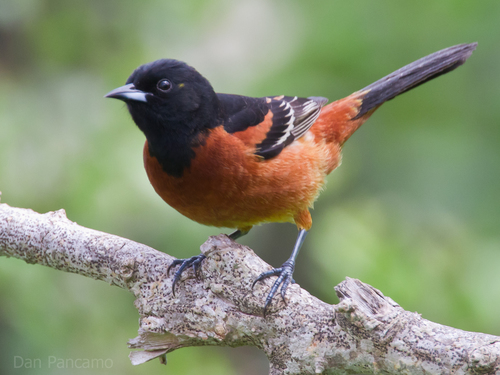
Orchard Oriole
Icterus spurius
Often overlooked in favor of their brighter orange cousins, the Orchard Oriole is a hidden gem of the bird world. Its deep chestnut tones and delicate song make it a rewarding discovery for any backyard observer with a sharp eye.
Quick Identification
Size
Length: 5.9–7.1 in (15–18 cm); Wingspan: 9.8 in (25 cm); Weight: 0.6–1.0 oz (16–28 g)
Colors
Adult males are black on the head and upper back with a deep, rich chestnut-red breast, belly, and rump. Females and immature males are olive-yellow with darker wings and two white wing bars.
Key Features
- Smallest North American oriole
- Adult males have deep brick-red or chestnut underparts
- Straight, sharply pointed black bill
- Two white wing bars on olive-green wings (females/juveniles)
- Slender build compared to other blackbirds
When You’ll See Them
Behavior
The Orchard Oriole is a master of stealth compared to its more flamboyant cousins. While Baltimore Orioles announce their presence with loud, flute-like whistles, the Orchard Oriole often stays hidden within the dense foliage of leafy trees. They are socially tolerant birds, sometimes nesting in close proximity to one another or even near other species like Eastern Kingbirds, which provide a communal defense against predators.
In the backyard, they are frequent visitors to nectar feeders and fruit stations, though they are easily spooked. They exhibit a unique foraging behavior called 'nectar robbing,' where they pierce the base of a flower to reach the sweet liquid without actually pollinating the plant. Despite their shy nature, they are active foragers, constantly moving through the canopy in search of protein-rich insects during the breeding season.
EverydayEarth exclusive
Camera Tips
Capturing the Orchard Oriole on camera requires a bit of finesse due to their preference for high-canopy living. To bring them down to lens level, set up a multi-offering station featuring a nectar feeder filled with sugar water (4:1 ratio) and a dish of grape jelly. Unlike larger orioles, Orchard Orioles have smaller bills, so ensure your jelly dish is shallow and easy to access. Placing a halved orange on a spike nearby provides a bright visual lure that can be seen from the treetops, acting as a beacon for passing migrants.
Position your camera 4 to 6 feet away from the feeding station at eye level. Because these birds are smaller and faster than many backyard visitors, use a camera with a high trigger speed (0.2 seconds or less) and set it to take 3-photo bursts. This increases your chances of getting a crisp shot of their distinctive chestnut plumage rather than just a blur of wings. If your camera allows for video, 10-second clips at 60fps are ideal for capturing their rapid, high-energy movements as they hover or perch near the feeder.
Water is another fantastic draw for this species. A birdbath with a solar-powered dripper or a small fountain is irresistible to Orchard Orioles, especially during the heat of June and July. Place the camera near the water source, angled slightly upward to capture the reflection and the bird's underside. Since they are early migrants, starting their journey south as early as late July, ensure your cameras are active and well-positioned by early May to catch the peak of their breeding season activity.
Lastly, consider the lighting. Because the male's chestnut color is quite dark, it can look black in deep shade or 'washed out' in direct midday sun. Position your camera facing north or south to avoid direct lens flare, and try to place your feeders in a spot that receives dappled morning light. This will highlight the rich, brick-red tones of the male and the subtle chartreuse of the female, making for much more professional-looking wildlife captures that showcase their unique color palette.
Similar Species
Species that look similar or are commonly confused with Orchard Oriole.
Frequently Asked Questions
Record Orchard Oriole at your habitat
Connect a camera to start building your own species record — AI identifies every visitor automatically.