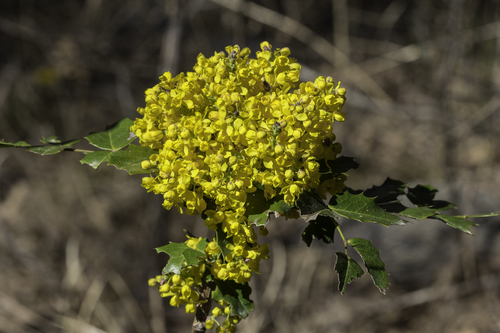
Oregon grape
Berberis aquifolium
The Oregon grape is a rugged, evergreen icon of the Pacific Northwest, boasting spiny holly-like leaves and vibrant golden blooms. It serves as a vital early-season banquet for pollinators and a year-round sanctuary for backyard birds.
Quick Identification
Size
A sturdy evergreen shrub typically reaching 1 to 3 metres (3 to 10 feet) in height and up to 1.5 metres (5 feet) in width.
Colors
Glossy dark green leaves that often turn bronze or burgundy in winter, bright sulfur-yellow flowers, and clusters of dusty dark-blue berries.
Key Features
- Holly-like leaves with sharp spines and 5-9 leaflets per stem
- Dense, rounded clusters of small yellow flowers in early spring
- Frosted, dark bluish-black berries that resemble tiny grapes
- Stiff, upright branches with distinctive yellow inner bark when cut.
When You’ll See Them
Geographic range
Where Does the Oregon grape Live?
The Oregon grape is native to the western regions of North America, stretching from the panhandle of Alaska and British Columbia down through the Pacific Northwest into the mountains of Northern California. While its heartland is the coastal and montane forests of Oregon and Washington, it has been successfully naturalized in many temperate regions across Europe and other parts of the United States. In its native range, it is a dominant understory species, frequently found clinging to rocky slopes or thriving under the canopy of towering conifers.
Basemap © OpenStreetMap contributors
Behavior
Oregon grape is a resilient perennial shrub known for its slow-to-moderate growth and extreme hardiness. While it remains stationary, it undergoes dramatic seasonal shifts that make it a centerpiece for backyard observations. In early spring, it produces a massive flush of nectar-rich yellow flowers that act as a primary food source for early-emerging pollinators. As summer progresses, these blooms transform into heavy clusters of berries that change from green to a deep, waxy blue.
This plant is highly valued for its ability to thrive in both full sun and deep shade, making it a versatile member of the forest understory. It exhibits a 'behavioral' response to cold temperatures by shifting its leaf pigment from deep green to a vibrant reddish-purple during the winter months. This anthocyanin production helps protect the plant from sun damage during cold snaps, providing year-round visual interest for humans and cover for small animals.
EverydayEarth exclusive
Camera Tips
When setting up a camera to monitor Oregon grape, think of the plant as a 'wildlife stage' rather than just a stationary subject. Because its flowers are highly attractive to early-season hummingbirds and mason bees, mount your camera approximately 3 to 5 feet off the ground, angled slightly downward toward the largest flower clusters. Use a high-speed trigger or a video setting to capture the rapid movement of pollinators during the spring bloom from March to May.
As the berries ripen in late summer, the focus of your camera should shift to avian visitors. Robins, towhees, and waxwings are frequent visitors to these 'grapes.' Position your camera on a nearby fence post or a tripod about 6 feet away to ensure a wide enough field of view to capture birds landing and feeding. Since the berries are dark, avoid placing the camera directly facing the sun, as the resulting silhouette will obscure the beautiful waxy blue detail of the fruit.
For a unique perspective, consider using your camera's time-lapse mode during the transition from winter to spring. The Oregon grape's leaves often shift from a deep burgundy back to bright green as the sap begins to flow, followed by the rapid emergence of yellow buds. Set your camera to take one photo every 4-6 hours over a three-week period in early spring to document this dramatic seasonal awakening.
Finally, don't overlook the plant's role as a ground-level shelter. Low-angled cameras pointed at the base of the shrub can capture secretive mammals like spotted skunks or brush rabbits that use the spiny, protective foliage to hide from predators. Ensure your infrared (IR) settings are optimized, as the dense, waxy leaves can sometimes cause 'hot spots' or glare when the flash hits them at close range during the night.
Frequently Asked Questions
Record Oregon grape at your habitat
Connect a camera to start building your own species record — AI identifies every visitor automatically.