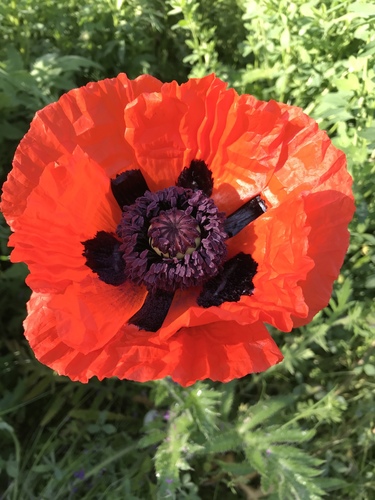
Oriental Poppy
Papaver orientale
With their massive, crinkled petals and striking midnight-dark centers, Oriental Poppies are the undisputed heavyweights of the late spring garden. These dramatic perennials offer a masterclass in texture and color, transforming from bristly buds into brilliant scarlet giants.
Quick Identification
Size
Height: 60-90 cm (24-36 in); Spread: 60-90 cm (24-36 in); Flowers: 10-20 cm (4-8 in) wide
Colors
Brilliant orange-red, scarlet, or salmon petals with deep purple-black centers; silvery-green foliage
Key Features
- Massive, crepe-paper-like petals with dark basal blotches
- Hairy, thistle-like silvery-green foliage
- Large, ornamental glaucous seed pods
- Deep, fleshy taproot and upright stems
When You’ll See Them
Behavior
The Oriental Poppy is a spectacular perennial that follows a distinct seasonal rhythm. In early spring, it produces a mound of feathery, bristly foliage that grows rapidly. By late spring or early summer, tall, hairy stems emerge, topped by heavy, nodding buds that eventually straighten and burst into some of the largest and most vibrant flowers in the temperate garden. These blooms are short-lived but intense, providing a massive reward for local pollinators.
One of the most unique 'behaviors' of this plant is its mid-summer disappearance. After flowering, the plant goes completely dormant to survive the heat, with the foliage turning yellow and dying back to the ground. It often experiences a second growth spurt of fresh green leaves in the cool of autumn. Because they possess a deep taproot, they are remarkably sedentary and do not like being moved once established, often living for decades in the same sun-drenched spot.
EverydayEarth exclusive
Camera Tips
Capturing the ephemeral beauty of an Oriental Poppy requires timing and specific camera placement. Set your AI camera on a low-profile garden stake or tripod at a height of about 24 to 30 inches. Position the lens slightly above the flower head, angled downward at a 45-degree angle. This allows the camera to see inside the 'cup' of the flower where the intricate black stamens and basal blotches are located—this is where the most visual drama happens.
To capture the 'unfolding' of a bloom, use a time-lapse mode rather than motion triggers. These flowers can transition from a tight, hairy green bud to a fully expanded 8-inch bloom in just a few hours during a warm morning. Set your interval to one frame every 10 minutes starting around 6:00 AM in late May. For still photography, the best light occurs during the 'Golden Hour' (shortly after sunrise), which highlights the translucent, papery texture of the petals and the fine silver hairs on the stems without blowing out the saturated reds and oranges.
If you are interested in wildlife interaction, keep the camera active even after the petals drop. The developing seed pods are a major draw for small backyard birds like goldfinches, who may land on the sturdy stems to investigate the pod or search for early-season insects. Ensure your camera's focus is locked on the flower center, as the sheer size of the petals can sometimes cause autofocus sensors to jump to the background. Using a 'Macro' setting if available will reveal the stunning, alien-like geometry of the central seed capsule.
Similar Species
Species that look similar or are commonly confused with Oriental Poppy.
Frequently Asked Questions
Record Oriental Poppy at your habitat
Connect a camera to start building your own species record — AI identifies every visitor automatically.