Oyster Pea Crab
Zaops ostreum
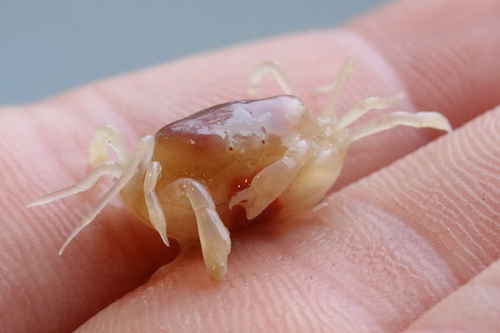
The ultimate coastal hitchhiker, the Oyster Pea Crab lives a secret life of luxury hidden inside the shells of living oysters. These translucent, pea-sized crabs are a marvel of evolution, trading their armor for a life of protected food-stealing.
Quick Identification
Size
Carapace width of 6–15 mm (0.25–0.6 inches); roughly the size of a green pea.
Colors
Translucent white, pale yellow, or soft pink; females are more opaque and light-colored, while males are slightly darker and harder.
Key Features
- Pea-shaped translucent body
- Soft, rounded carapace (in females)
- Reduced legs adapted for life inside a shell
- Small eyes often obscured by the shell
When You’ll See Them
Geographic range
Where Does the Oyster Pea Crab Live?
Native to the Western Atlantic Ocean, the Oyster Pea Crab is a common resident of coastal estuaries from the temperate waters of Massachusetts down through the Gulf of Mexico. This tiny crustacean follows the distribution of its primary host, the Eastern Oyster, thriving in the brackish bays and lagoons of the United States and extending its reach as far south as the shores of Brazil. Wherever healthy oyster reefs are found along the Atlantic coast, these clever hitchhikers are likely to be present.
Basemap © OpenStreetMap contributors
Behavior
The Oyster Pea Crab is a fascinating example of a specialized lifestyle known as kleptoparasitism. These tiny crabs enter an Eastern Oyster as larvae and spend nearly their entire lives tucked safely within the host's mantle cavity. Instead of preying on the oyster itself, they act as food thieves, intercepting the strings of nutrient-rich plankton and mucus that the oyster filters from the water. Because the oyster's shell provides ultimate protection, the female pea crab has evolved a very soft, delicate body, losing the heavy armor typical of other crab species.
Socially, these crabs are usually solitary residents, though a single large oyster may occasionally host more than one. Females are essentially permanent prisoners of their host, becoming too soft and heavy to survive in the open water. In contrast, the smaller, hard-shelled males are more mobile and may leave their host to swim in search of a mate. For humans, they are most often encountered as a surprise discovery while shucking oysters; historically, they were considered a rare gourmet delicacy and were a favorite of George Washington.
EverydayEarth exclusive
Camera Tips
Capturing the Oyster Pea Crab on camera requires a specialized approach because they live their lives hidden inside another animal. For coastal backyard explorers with a dock or shoreline access, the best way to document them is through a dedicated macro photography setup rather than a traditional trail camera. Use a camera with a macro lens (60mm to 105mm) and a high-intensity ring light or dual external flashes. This lighting is crucial for highlighting the crab’s translucent body and internal organs, which are often visible through its soft shell.
If you are using an underwater action camera near an oyster reef, focus on the "gaping" of the oysters during a clear-water high tide. While you likely won't see the crabs inside, you may capture the smaller, hard-shelled males during the late summer mating season as they emerge to swim between host oysters. Set your camera to a high frame rate (at least 60fps) to catch their frantic, tiny movements against the current. Using a tripod to keep the camera perfectly still against the reef is essential for focus.
For the most detailed observations, set up a small "studio" aquarium filled with brackish water from the collection site. Place a shucked crab in a clear glass petri dish within the tank. Use side-lighting to create a "darkfield" effect, which makes the translucent crab glow against a dark background. This allows you to film their delicate grooming behaviors and the way they use their specialized legs to sort through food particles. Always ensure the water temperature remains stable and return the crab to the estuary immediately after filming.
Frequently Asked Questions
Record Oyster Pea Crab at your habitat
Connect a camera to start building your own species record — AI identifies every visitor automatically.