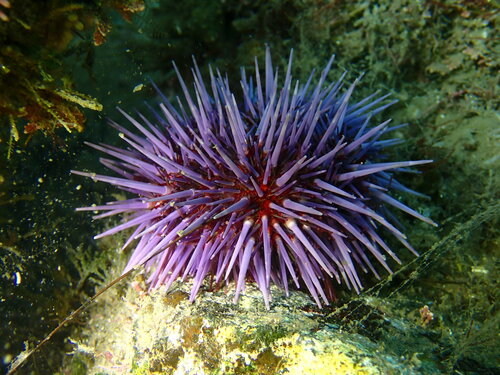
Pacific Purple Sea Urchin
Strongylocentrotus purpuratus
A vibrant purple sentinel of the Pacific shoreline, this spiny invertebrate is famous for its ability to carve its own home out of solid stone. Found in tide pools from Mexico to Canada, it is a keystone species that holds the balance of the underwater kelp forest in its teeth.
Quick Identification
Size
Body (test) diameter of 2 to 4 inches (5 to 10 cm); spines typically add another 1 to 2 inches (2.5 to 5 cm) to the overall width.
Colors
Adults are a deep, vibrant purple or violet; juveniles often appear greenish, pale gray, or light purple before their color saturates with age.
Key Features
- Spherical body densely covered in short, stiff purple spines
- Five-toothed mouth called 'Aristotle's lantern' located on the underside
- Rows of small, clear tube feet used for movement and respiration
- Often found wedged into circular pits they have bored into solid rock
When You’ll See Them
Sightings on EverydayEarth
Mar 17, 2026
A California spiny lobster navigates across the rocky reef floor in a kelp forest. It moves toward the center of the frame, passing by a purple sea urchin while kelp fronds sway in the background.
Jun 15, 2026
A California Spiny Lobster crawls across a rocky reef, using its long antennae to probe the environment as it moves past a purple sea urchin and swaying kelp fronds.
Apr 1, 2026
A vibrant orange Garibaldi swims gracefully through the kelp forest, approaching the camera before turning to forage among the rocks. The view then shifts to show a cluster of purple sea urchins on the reef surface, with a camouflaged fish seen briefly in the background.
Mar 31, 2026
A bright orange Garibaldi swims through a rocky underwater environment, moving towards and then away from the camera. The seafloor is populated with numerous purple and red sea urchins nestled among various species of red and green algae. A Kelp Bass is briefly seen swimming past in the background.
Mar 29, 2026
A vibrant orange Garibaldi swims through a kelp forest, eventually moving close to the camera. Several Pacific Purple Sea Urchins are seen anchored to the rocks below. In the background, a Kelp Bass and a slender yellowish fish move between the marine vegetation and rocky crevices.
Mar 27, 2026
A vibrant orange Garibaldi swims through a rocky reef, eventually moving toward a group of Pacific purple sea urchins clustered on the seafloor. A California Sheephead and a Kelp Bass are also visible in the background, patrolling the kelp forest environment.
Behavior
Socially, they are often found in high-density clusters, which can lead to the formation of 'urchin barrens'—areas where the population has become so large that they have consumed all available kelp forests. Their behavior is heavily influenced by the presence of predators; when sea otters or large sunstars are nearby, urchins remain hidden in their rocky crevices. In the absence of these predators, they become bold grazers, moving across the seabed in large fronts that can significantly alter the underwater landscape.
EverydayEarth exclusive
Camera Tips
Lighting is crucial in the underwater environment. While daylight captures their vibrant purple color beautifully, their most interesting feeding behaviors occur at night. If your camera has infrared (IR) capabilities, you can witness them extending their tube feet to grab pieces of kelp from the water column. Avoid using high-intensity white lights at night, as this can startle other marine life in the pool. Instead, rely on ambient light or low-glow IR. Because salt water is highly corrosive, it is vital to rinse your camera housing and mounts thoroughly with fresh water after every deployment to protect the seals and lens quality.
To encourage movement in front of the lens, you can place a small piece of fresh kelp nearby, though the natural surge of the tide usually brings enough drift kelp to keep them active. Focus your camera on 'urchin pits'—the depressions they carve into the rock—as these are their home bases. By using a time-lapse setting (one frame every 5-10 seconds), you can compress hours of tide changes into a few seconds, revealing the surprisingly fluid and constant motion of what otherwise looks like a stationary rock. The best footage is often captured in the thirty minutes before and after the tide fills the pool, as this is when the urchins transition from a dormant state to active foraging.
Similar Species
Species that look similar or are commonly confused with Pacific Purple Sea Urchin.
Frequently Asked Questions
Record Pacific Purple Sea Urchin at your habitat
Connect a camera to start building your own species record — AI identifies every visitor automatically.