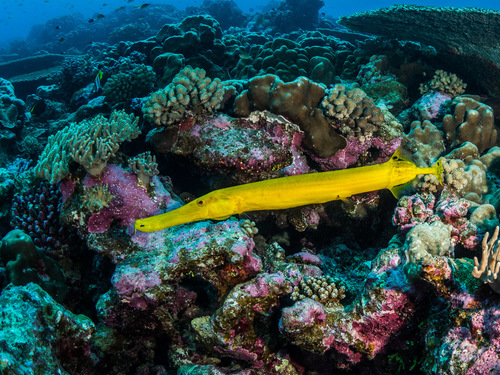
Pacific Trumpetfish
Aulostomus chinensis
The ultimate reef ninja, the Pacific Trumpetfish uses vertical camouflage and 'shadowing' techniques to become invisible to its prey.
Quick Identification
Size
Typically 30–50 cm (12–20 in) in length, but can reach a maximum of 80 cm (31 in)
Colors
Highly variable; occurs in three main color phases: bright yellow, mottled brownish-green, or grey with thin longitudinal stripes. Can change color rapidly for camouflage.
Key Features
- Elongated, laterally compressed body
- Long tubular snout with a small, expandable mouth
- Single barbel on the chin for sensing prey
- Row of 8-12 isolated dorsal spines before the soft dorsal fin
When You’ll See Them
Geographic range
Where Does the Pacific Trumpetfish Live?
The Pacific Trumpetfish is a widespread resident of the tropical and subtropical waters of the Indo-Pacific region. Its native range spans from the eastern coast of Africa and the Red Sea all the way across the Indian Ocean to the Hawaiian Islands and Easter Island in the Pacific. It is frequently encountered in the coral-rich waters of Australia, Indonesia, the Philippines, and as far north as the southern islands of Japan. Because it relies heavily on healthy reef structures, its presence is a hallmark of vibrant marine ecosystems across Oceania and Southeast Asia.
Basemap © OpenStreetMap contributors
Behavior
The Pacific Trumpetfish is a master of stealth and mimicry on the coral reef. One of its most fascinating behaviors is 'shadowing,' where it swims closely alongside or even on top of a larger, non-predatory fish like a grouper or a parrotfish. This allows the trumpetfish to hide its silhouette and sneak up on unsuspecting prey. It is also famous for its vertical orientation, often hanging motionless with its head down among sea whips, grasses, or gorgonians to blend into its surroundings.
While generally solitary, they are not particularly shy around humans and can be observed by snorkelers and divers quite easily. They are diurnal hunters, spending most of the daylight hours hovering near coral structures waiting for the perfect moment to strike. When a target is within range, the trumpetfish uses 'elastic recoil' suction feeding, expanding its snout rapidly to create a vacuum that pulls the prey into its mouth.
EverydayEarth exclusive
Camera Tips
Capturing the Pacific Trumpetfish on a backyard marine camera or a reef-mounted trail cam requires an understanding of their vertical camouflage. Because they often hang head-down among vertical structures, place your camera with a view of sea whips, tall sponges, or rope corals. Using a weighted tripod or a clamp mount on a dock piling or a stable rock formation is essential to keep the frame steady in moving currents.
For the best clarity, set your camera in shallow water (under 5 meters) where natural sunlight is abundant. If you are filming deeper or in a shaded reef crevice, you will need high-intensity underwater video lights to reveal their vibrant yellow or mottled green colors, which otherwise appear grey or blue at depth. Use a wide-angle lens, but try to position the camera within 1 to 2 meters of a known 'stalking' spot, as these fish are relatively stationary until they strike.
Because the trumpetfish's strike is one of the fastest movements in the animal kingdom, use a high frame rate (at least 60fps or 120fps) if your camera allows. This will enable you to see the incredible expansion of their tubular snout in slow motion. To attract them, you don't necessarily need bait; instead, look for areas with high concentrations of 'glassfish' or small damselfish, which are their primary food sources. If you notice a large, slow-moving fish like a snapper frequently passing by, point your camera there—the trumpetfish is likely shadowing it just out of sight.
Frequently Asked Questions
Record Pacific Trumpetfish at your habitat
Connect a camera to start building your own species record — AI identifies every visitor automatically.