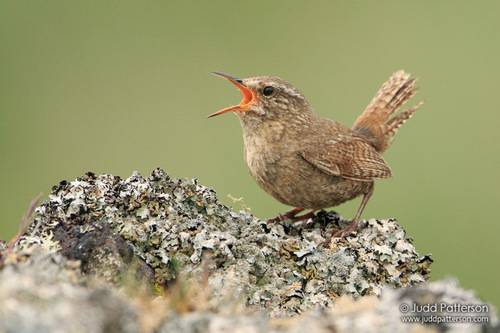
Pacific Wren
Troglodytes pacificus
A tiny powerhouse of the Pacific Northwest, the Pacific Wren is famous for its mouse-like movements and a song so loud it seems to defy physics. Discover how to spot this secretive forest-dweller in the shadows of your own backyard.
Quick Identification
Size
Length: 3.1–4.7 in (8–12 cm); Wingspan: 4.7–6.3 in (12–16 cm); Weight: 0.3–0.4 oz (8–11 g)
Colors
Uniformly dark brown overall with subtle dark barring on the wings, tail, and belly; feature a pale tan line above the eye (supercilium). Males and females are identical in plumage.
Key Features
- Extremely short, stubby tail often held upright
- Tiny, round, 'ping-pong ball' body shape
- Deep cocoa-brown color with fine dark scalloping
- Incredibly loud, complex song for such a small bird
When You’ll See Them
Behavior
The Pacific Wren is a master of the forest floor, often behaving more like a mouse than a bird. They are incredibly energetic and secretive, preferring to stay tucked away in dense underbrush, fallen logs, and root balls. You will often see them 'bobbing' their entire bodies—a nervous, rhythmic motion that is a classic tell-tale sign of a wren. Despite their tiny size, they are fiercely territorial and possess one of the most complex and powerful songs in the bird world, capable of being heard through thick forest canopies.
In a backyard setting, they are less likely to visit a hanging feeder and more likely to be found investigating the dark corners of your garden. They move in quick, jerky bursts, hopping between low branches and scurrying through leaf litter. While they are not overly social with other species, they are generally tolerant of humans if you provide enough cover for them to feel secure.
EverydayEarth exclusive
Camera Tips
Capturing the Pacific Wren on camera requires a strategy focused on the ground level. Unlike hawks or songbirds that prefer high perches, these wrens spend 90% of their time within two feet of the forest floor. Mount your camera very low—ideally 6 to 12 inches off the ground—and angle it slightly upward if it's placed near a favorite log or stone. Because they are so small and move with lightning-fast, 'twitchy' movements, set your camera to its fastest trigger speed (0.2s or less if possible) and use a high-speed burst mode or high-frame-rate video to avoid getting a gallery of blurry brown feathers.
The best 'lure' for a Pacific Wren is a brush pile or a low-profile water feature. If you have a corner of your yard with old branches, blackberry brambles, or decaying logs, point your camera there. They are naturally curious and will investigate every nook and cranny. A dripping birdbath or a ground-level pond with a small fountain is also a magnet for them, as they need to bathe and drink frequently but prefer to stay close to the ground for safety.
During the winter months, you can entice them into camera range using mealworms or high-quality suet crumbles placed in a low, protected tray. However, the most reliable way to get a 'hero shot' is to locate a singing perch. During the spring, males often choose a specific stump or exposed root to belt out their long, trilling songs. If you notice a wren singing from the same spot repeatedly, that is the perfect location for a long-term camera setup. Use a 'Macro' setting if your camera supports it, as these birds are often photographed at very close range.
Similar Species
Species that look similar or are commonly confused with Pacific Wren.
Frequently Asked Questions
Record Pacific Wren at your habitat
Connect a camera to start building your own species record — AI identifies every visitor automatically.